The numbers people want are simple, and you will find them below. The part worth understanding first is what happens in the sixty seconds after you get in, because that is where the entire risk of this practice sits, and it is the reason every safety rule exists.
Temperature and Time Are One Dose
Most guides give you a temperature chart and a duration chart as though you set them independently. You do not. Five minutes at 60 degrees F and ninety seconds at 45 degrees F are different events with different physiological loads.
Colder water means shorter sessions. As you go down in temperature, you go down in time. People who ignore that pairing are the ones who end up shivering uncontrollably in a parking lot wondering what went wrong.
How Cold
Level | Water Temperature | Notes |
|---|---|---|
Starting out | 55 to 60 degrees F | Cold enough to produce the response. Manageable enough to learn to breathe through it. |
General practice | 50 to 59 degrees F | Where most research sits. Many protocols cluster near 52 to 54. |
Experienced | 40 to 50 degrees F | Shorter sessions only. Not a target to rush toward. |
Below 40 degrees F | Advanced | Meaningfully higher risk. Not necessary for the reported effects. |
The useful thing to know is that you do not need extreme cold. The commonly cited research on mood and alertness effects used water around 57 degrees F, which is uncomfortable but nowhere near ice. Going colder is a choice, not a requirement.
How Long
Level | Session Length |
|---|---|
First few weeks | 30 seconds to 2 minutes |
Building | 2 to 3 minutes |
Established practice | 2 to 5 minutes |
Rarely useful | Beyond 10 minutes |
A widely repeated target is around 11 minutes of total cold exposure per week, split across two or three sessions. It is a reasonable goal and it is worth knowing where it came from. The participants in the underlying work were experienced winter swimmers, all male, with at least two years of regular practice. That is a destination, not a starting point, and it may not translate evenly to everyone.
A practical way to judge a session: get out while you still feel steady and clear headed. Chasing your maximum is where the risk sits and the benefit does not increase to match.
What Happens in the First Minute
This is the part worth reading twice.
Entering cold water triggers what researchers call the cold shock response. It is involuntary. Within seconds you take a sharp reflexive gasp, your breathing rate jumps, your heart rate rises, your blood vessels clamp down, and your blood pressure spikes. Measurements in the literature show pressure rising from around 130 over 76 at rest to roughly 175 over 93 after about a minute of ice water exposure.
Three things follow from that.
- The gasp is why your face should never go under on entry, and why nobody should plunge alone. In open water this reflex is a leading cause of drowning.
- The hyperventilation blows off carbon dioxide, which shifts blood chemistry and in severe cases can cause dizziness or loss of consciousness. Controlling your breathing is not a wellness flourish, it is the safety mechanism.
- The blood pressure and heart rate response is a real cardiovascular event. For a healthy person it is manageable. For someone with heart disease it may not be.
The response peaks in the first sixty to ninety seconds and settles after about three minutes. Getting through that window calmly is the skill. It also habituates, so a handful of short exposures make the response noticeably milder.
Anxiety Makes the Response Stronger
Research on cold water immersion has found that people who go in anxious experience a larger cold shock response than people who go in calm, and that persistent anxiety across sessions can delay the adaptation that normally develops.
So the advice to breathe slowly and enter deliberately is not atmosphere. Going in tense measurably raises the physiological stress. Enter slowly, breathe out longer than you breathe in, and do not let anyone rush or dare you.
Getting Out Is Not the End
Your core temperature can continue to fall after you exit, because cold blood in your arms and legs returns to the center of your body as circulation opens back up. This is called afterdrop, and it is why you can feel worse ten minutes after a plunge than during it.
During that rewarming period, attention and coordination are measurably impaired. The practical consequence, which almost nobody mentions, is straightforward: do not get straight into a car after a long cold session. Rewarm properly first.
Rewarm actively but gently. Dry off, put on warm layers, move around, and have a warm drink. Going directly into very hot water is a harsher transition than it needs to be.
How Often
Two to five sessions a week suits most people. Consistency at a moderate temperature builds adaptation faster than occasional extreme attempts, and daily exposure is not required for the reported effects.
If sessions start leaving you drained rather than clear, that is the signal to reduce frequency or duration rather than push harder.
Pairing Cold With Heat
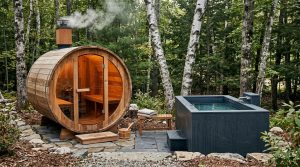
Contrast bathing is the traditional structure, and it is the reason a cold plunge sits next to a sauna rather than on its own.
A common pattern is 10 to 15 minutes of heat followed by 1 to 3 minutes of cold, repeated two to four times. The cold rounds stay short because you are entering already vasodilated and warm, which makes the transition sharper.
One caution on the sequence. If you have just finished heavy resistance training, cold immersion immediately afterward may work against the muscle adaptation you trained for. If building strength is the goal, put the cold on a different day or leave several hours between them.
You Do Not Need an Expensive Tub
Every guide on this subject seems to end at a temperature controlled unit costing several thousand dollars. That is one option, not the requirement.
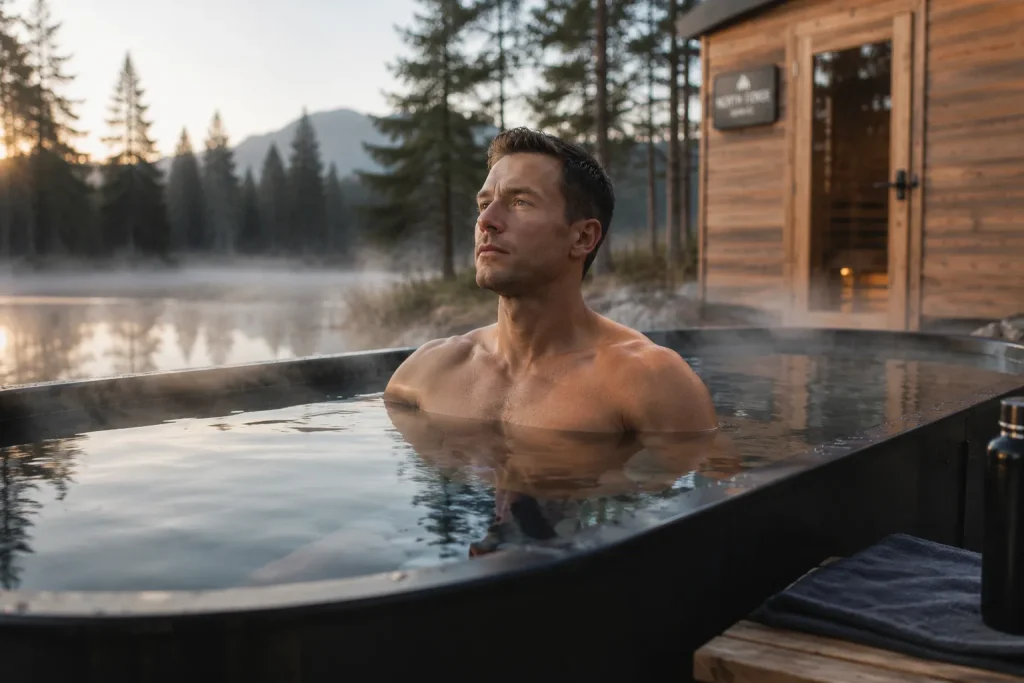
A bathtub with bagged ice works. A livestock stock tank works and costs very little. Cold natural water works and is free, though open water carries its own separate set of hazards around depth, current, and exits, and should be treated accordingly.
What matters is the temperature, the time, and doing it repeatedly. The container is incidental.
Who Should Not Do This
Cold immersion is not for everyone, and the reasons are specific rather than precautionary boilerplate.
- Heart disease, previous heart attack, stents, arrhythmias including atrial fibrillation, cardiomyopathy, or heart failure. The cold shock response raises heart workload and can provoke rhythm problems.
- Uncontrolled high blood pressure, given the documented pressure spike on entry.
- Asthma or other lung conditions, since cold exposure can trigger airway constriction.
- Pregnancy.
- Raynaud phenomenon or circulation disorders.
- After drinking. Alcohol does not blunt the cold shock response, it impairs your judgment of how cold you are, and it worsens afterdrop.
If any of these apply, speak to a doctor before starting rather than after. This is one of the areas where the caution is not a formality.
Get Out Immediately If
- You cannot get your breathing under control after the first minute.
- You feel chest pain or pressure.
- You become dizzy, confused, or your speech slurs.
- You lose dexterity or coordination.
- Shivering becomes violent and uncontrollable.
- Your extremities go numb or turn blue.
A Starting Protocol
- Week one: 55 to 60 degrees F, 30 to 60 seconds, twice.
- Week two: same temperature, 60 to 90 seconds, twice or three times.
- Week three: drop a few degrees or add thirty seconds. Change one thing, not both.
- Week four onward: settle around 50 to 55 degrees F for 2 to 3 minutes, three times a week.
- Enter slowly. Keep your face out. Breathe out longer than you breathe in.
- Have someone nearby, or at minimum someone who knows you are in there.
- Rewarm properly before doing anything that needs coordination.
The Short Version
Around 50 to 59 degrees F, two to five minutes, two to five times a week. Start warmer and shorter than you think you need to. Treat the first minute as the whole exercise, because physiologically it nearly is. And get out while you still feel good rather than finding out where your limit is.