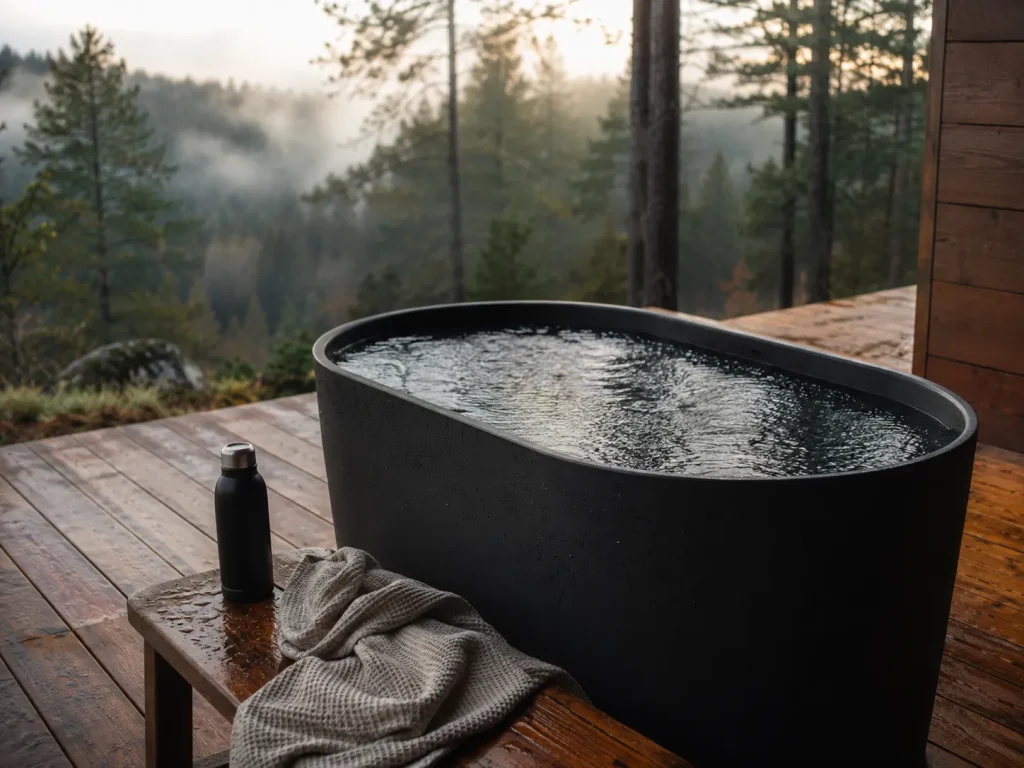
The most reliably demonstrated effect of ice baths is that they make you better at ice baths.
That sounds like a joke and it is not. Cold habituation is the one adaptation in this whole area that has been measured repeatedly, holds up across studies, and produces a clear physiological change. Most of the other claims are shakier than the confidence around them suggests.
Here is what actually happens, separated into what occurs in the moment and what changes over time, because those are very different pictures.
In the first thirty seconds
The cold shock response is the most dramatic thing your body does in an ice bath, and it happens immediately.
Skin cold receptors fire. You take an involuntary gasp. Breathing rate jumps. Heart rate surges. Blood vessels at the surface clamp shut, pushing blood toward your core, and blood pressure rises sharply.
That gasp is the reason cold water immersion carries a drowning risk that a cold shower does not. If your head goes under while it happens, you inhale water.
This response peaks in the first thirty seconds and settles over the next two or three minutes. Almost everything people describe as the ice bath experience is this, not the cold itself.
Over the next few minutes
Once the shock passes, the picture is mostly circulatory.
Surface vessels stay constricted. Core temperature drops slowly, more slowly than most people assume, because your body is defending it hard. Shivering may start, which is your metabolism raising heat production.
Noradrenaline rises. This is the finding most often quoted in cold plunge marketing, usually with a large percentage attached. The number people cite comes from a study using an hour of immersion, which is far longer than anyone actually plunges, and it is a stress response rather than a benefit in itself. Sprinting produces something similar.
The alertness people feel afterward is real and it comes from this. Deciding if it is worth the discomfort is a personal question rather than a scientific one.
Why the mood effect is hard to pin down
People consistently report feeling better after cold water. That is not in dispute. What it means is.
Three explanations compete and none of them has been separated out cleanly. The noradrenaline and dopamine release is one. The sense of having done something difficult is another, and accomplishment reliably improves mood on its own. The third is that most people plunge in the morning, outdoors, often with other people, and every one of those things independently affects how you feel.
A trial that controlled for all of it would need a convincing placebo for cold water, which nobody has managed to design.
So the practical position is that the mood lift is real as an experience and unproven as a specific effect of cold. If it works for you, that is sufficient reason to keep doing it. It is not a reason to expect it to work for everyone, and some people find cold exposure genuinely worsens their state rather than improving it.
What actually adapts: habituation
This is the effect worth building a page around, and it is the one nobody leads with.
Repeated cold water immersion substantially blunts the cold shock response. After a handful of exposures, the gasp is smaller, the heart rate surge is reduced, and the whole entry becomes manageable in a way it was not on day one.
This is a genuine, measurable neurological adaptation. It is also the mechanism behind cold water safety training for people who work on or near water, which tells you how seriously it is taken.
So when somebody asks what happens after thirty days of ice baths, this is the honest answer: you become considerably better at getting into cold water. That is not nothing. It is a real capability and it transfers to any cold water situation.
What does not clearly change in thirty days is your immune function, your metabolism, your body composition, or your baseline mood. Those are the claims attached to the practice, and they are much less well supported than the habituation finding.
The soreness effect is real
Cold water immersion reduces delayed onset muscle soreness compared with doing nothing. This has been shown enough times to treat as established.
Two caveats that matter. It does not clearly outperform other recovery methods like active recovery. And after resistance training specifically it appears to reduce the adaptation you trained for, which is a trade rather than a free win. The timing question covers that properly if you lift.
What is oversold
Metabolism and fat loss. Cold exposure does activate brown adipose tissue and does increase energy expenditure while you are cold. The amounts involved are small, adults have limited brown fat, and no good evidence supports meaningful fat loss from plunging.
Immunity. The evidence here is thin and inconsistent. The often-cited studies mix cold showers with breathing techniques and other variables, which makes attributing anything to the cold alone difficult.
Detoxification. Nothing is being flushed. Your liver and kidneys handle that and cold water does not assist them.
Inflammation reduction as an unqualified good. Suppressing inflammation is helpful when you want to recover fast and unhelpful when you want to adapt. Context decides which one applies.
The downsides
Cold shock is the acute risk, and it is the one that kills people. Gasping underwater, or losing swimming ability in the first minute, is how cold water drowning happens.
Afterdrop is the delayed one. Core temperature can continue falling for a while after you get out, as cold blood from the limbs returns to the core. This is why you warm up gradually rather than jumping into a hot shower, and why the guidance on how cold and how long is worth following rather than improvising.
Cardiovascular strain is the one that needs a doctor. Blood pressure spikes and heart rate surges on entry. For anyone with cardiovascular disease, uncontrolled hypertension or an arrhythmia this is a serious consideration and the cardiovascular picture is worth understanding first.
Nerve damage from prolonged exposure is rare but real, particularly in extremities.
And there is the ordinary one: most people who buy into this stop within a few months, which is worth factoring in before spending money.
Skin and the face
Cold constricts surface blood vessels, which temporarily reduces puffiness and redness. That effect is real and it lasts about as long as the constriction does. It does not treat acne, it does not shrink pores permanently, and it does not do anything structural.
Rosacea is worth flagging in the other direction. Rapid temperature swings are a known trigger for some people, and that includes cold as well as heat. There is more on heat and skin, and the same caution applies to the cold half.
Is daily too much
There is no established maximum and no evidence that daily exposure produces better outcomes than two or three times a week.
The honest guidance is that frequency should be whatever you can sustain without dreading it. The habituation effect builds with repetition, so consistency matters more than intensity, and that is the same conclusion the sauna research keeps reaching from the other direction.
If you lift, avoid the window immediately after training regardless of how often you go.
Cold alone or cold with heat
Most of the interest now sits in the combination rather than in cold on its own, and that is a reasonable place to end up.
There is separate coverage of what the combination actually does. The equipment question also comes up constantly, and it is the same exposure from different equipment, so that choice matters less than people expect.
The bottom line
In the moment, an ice bath produces a large and genuine stress response: gasp, heart rate surge, blood pressure spike, vasoconstriction, and a noradrenaline release you can feel for an hour afterward.
Over time, the effect with the best evidence is habituation. You get better at cold. That is a real adaptation and it is more modest than what the practice is usually sold on.
Soreness reduction is well supported. Metabolism, immunity and detoxification claims are not, and the training-adaptation trade-off means the timing matters more than the frequency.
If you are setting this up alongside heat rather than on its own, a private setup makes the sequencing far easier to run than working around a shared facility.