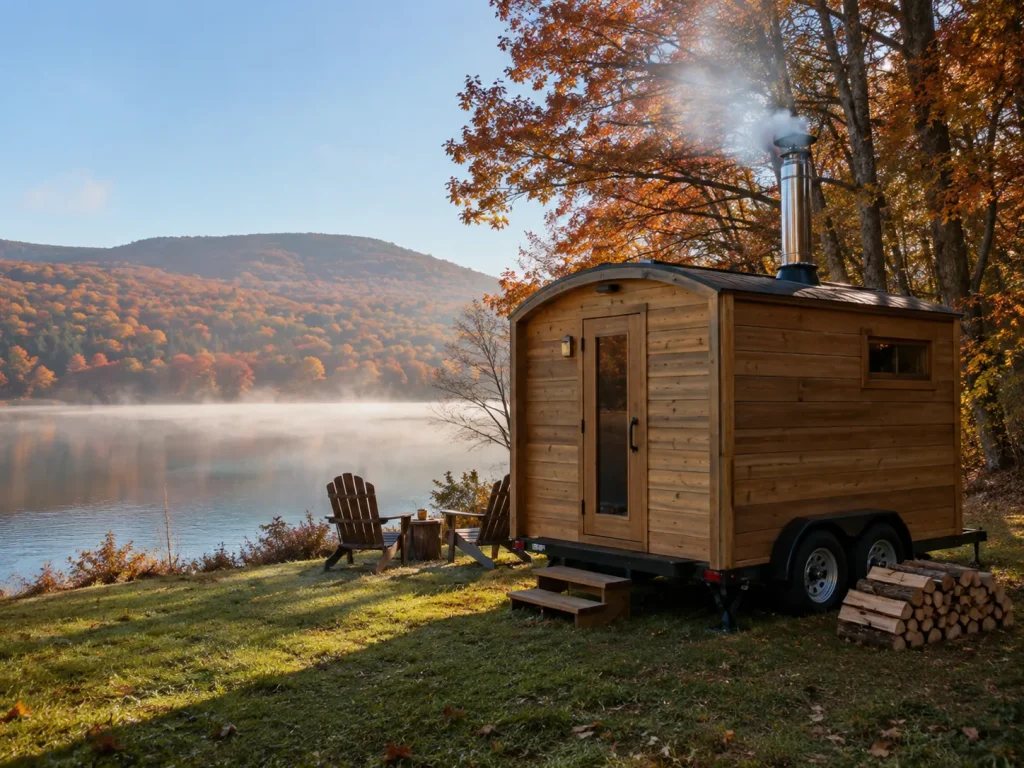
There is a reason the sauna tradition grew up around lakes and forests rather than gyms. Heat means more when there is cold water nearby and nowhere in particular to be afterward.
A mobile sauna is the one piece of wellness equipment that does not need the grid. No outlet, no plumbing, no hookups, just wood, fire, and a place to park. That makes it the rare amenity you can genuinely bring to a campsite, a cabin, a lake house, or a piece of family land in the woods.
This guide covers where it works in Connecticut, what to check before you book, and how to plan the trip properly.
Why It Works Outdoors
Most rented experiences lose something outside. A sauna gains.
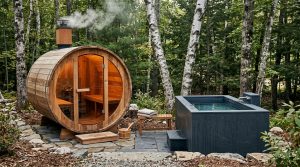
- There is cold water. A lake, a river, or a stream turns a good sauna session into a proper contrast cycle, which is the whole tradition.
- There is nowhere to rush to. On a camping or cabin weekend, a two-hour sauna session is not competing with anything.
- It solves the weather problem. Cold, damp, and grey weather ends most outdoor trips early. A sauna makes those exact conditions better.
- It is the social center. On group trips, it does what a campfire does, gathers everyone in one place, without needing a plan.
- It handles the recovery. After a day of hiking, paddling, climbing, or cutting firewood, heat does more for a group than another round of stretching.
It Runs Completely Off-Grid
This is the part that surprises people, so it is worth being direct about.
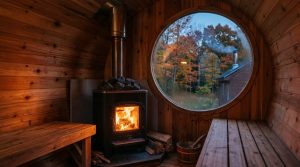
A wood-fired sauna needs no electricity and no plumbing. Heat comes from burning wood in a stove, and water for the rocks comes from a bucket. There is nothing to plug in, nothing to connect, and no generator required.
What that means practically: the unit works at a site with no services at all. A field, a clearing, a gravel pad by a lake, a dirt turnaround at a hunting camp. If a truck can get there and there is level ground, the sauna works.
The only reason you would want power or water nearby is for optional add-ons, lighting or a filled cold plunge tub. The sauna itself does not care.
Where It Works in Connecticut
| Location Type | Realistic? | What Determines It |
| Private cabin or lake house you own | Yes, the easiest case | Just access and a level spot |
| Family land or woodlot | Yes | Road condition and turnaround room |
| Private campground | Often, with approval | Management policy on open flame and outside equipment |
| State park or state forest campground | Generally no | Public campgrounds rarely permit outside commercial equipment |
| Rented cabin or vacation property | Often, with host approval | Owner permission, in writing |
| Hunting or fishing camp | Yes | Access road and seasonal conditions |
| Retreat center or private group venue | Often | Venue approval and insurance requirements |
| Private lakefront association property | Sometimes | Association rules on trailers and fires |
| Dispersed or roadside camping | No | No legal parking or permission structure |
The Permission Question
This is the question every camper has and no rental company answers, so here is the honest version.
State Park and State Forest Campgrounds
Connecticut’s state parks and forests run a good network of campgrounds, most of them concentrated in the Litchfield region. In practice, they are not a realistic fit. Public campgrounds are set up for tents, RVs, and rented cabins, and bringing in outside commercial equipment with a wood-burning stove sits outside what those sites are designed to permit. Assume no unless you have written confirmation otherwise.
Private Campgrounds
Much better odds. Private campgrounds across Litchfield County and the shoreline vary widely in what they allow, and many are receptive if you ask in advance and explain what is arriving. Some will want to see the site plan or restrict which loop you can park in. Ask when you reserve, not the week before.
Rented Cabins and Vacation Properties
Get the owner’s approval in writing before booking the sauna. Most hosts are enthusiastic, a wood-fired sauna is a genuine draw for their property, but a wood-burning appliance and a trailer in the driveway are not things to spring on someone after arrival.
Your Own Property
The simplest case by far. If you own the cabin, the lake house, or the land, the only questions are practical ones.
Getting to Remote Sites
A sauna trailer travels behind a truck, which means the route matters more than the destination.
- Unpaved and gravel roads are usually fine when they are firm and reasonably graded.
- Seasonal and unmaintained roads are the common failure point, particularly in the northwest hills.
- Mud season, roughly March into April, turns passable dirt roads into ruts. This is the hardest window of the year for remote delivery.
- Camp lanes are frequently narrower than they look, and tree canopy over a wooded lane can be too low for a trailer.
- Steep or washed-out approaches to lakefront sites are a real limit.
- There has to be room to turn a truck and trailer around, or a route through.
If your site is remote, send photos of the access road and the parking area when you enquire. That takes a few minutes and prevents a wasted trip. Our setup requirements guide covers the specific measurements to check.
Using Natural Cold Water
A lake, river, or stream next to a hot sauna is the best version of this experience there is. It is also the part that requires real care, and most guides skip it entirely.
If you plan to cool off in natural water, treat it seriously:
- Never enter the water alone, and never after drinking. Both are how cold water incidents happen.
- Know the depth and the bottom before you get in. Walk in, do not jump or dive.
- Understand the current. Rivers and streams move faster than they look, and cold muscles respond slowly.
- Keep immersion brief. The point is a sharp cold shock, not endurance. Get out well before you start shivering hard.
- Have a clear, non-slippery exit route planned before you enter. Wet rocks and steep banks are the real hazard.
- In cold months, natural water immersion is for experienced cold-water swimmers only. Cold shock is a genuine physiological event, not a matter of willpower.
- Nobody should feel obligated. Stepping outside into cold air is a perfectly good cool-down.
If natural water is not available or not safe at your site, a garden hose, a bucket of cold water, or simply the outdoor air does the job.
The Best Time of Year for a Camp Sauna
Most Connecticut camping is planned around summer, but summer is the weakest season for a sauna. The shoulder seasons are far better.
| Season | Why It Works |
| Late spring (May to June) | Cool evenings, water still cold enough to matter, campgrounds open and not yet crowded. An excellent window. |
| Summer (July to August) | The weakest season. Hot days make the contrast less appealing. Best used in the evening or at a lake site. |
| Early fall (September to October) | The best of the year. Cold nights, warm days, peak foliage in the northwest hills, and water cold enough for a proper plunge. |
| Late fall (November) | Excellent if your site is still accessible. Campgrounds are closing, but private cabins and land are wide open. |
| Winter | A different experience entirely, and worth its own planning. Cabin and lake-house rentals stay strong all winter. |
Note that most Connecticut state park campgrounds operate roughly from late May through mid-October, while private campgrounds and cabin rentals often run longer or year-round. If you want the sauna at its best, aim for September and October.
Group Trips and Splitting the Cost
These trips are rarely solo. A cabin weekend is usually four to eight people, and that changes the maths considerably.
A weekend rental starting at $600 across six people is roughly $100 each for two nights of unlimited use, less than a single spa session, and the sauna is available at any hour, as many times as you like. Split among a group, it stops being a splurge and starts being a normal line item alongside firewood and food.
For a single day, a day trip to the lake, a post-race gathering, a one-night cabin stay, a half-day rental starting at $400 covers delivery, setup, the afternoon, and same-day pickup.
Delivery is included for the first thirty miles from Plainville. That radius reaches a good part of the Litchfield Hills and much of Central Connecticut, with a flat per-mile rate beyond it.
Planning Checklist
- Confirm the location will allow it, campground management, property owner, or association, in writing where possible.
- Check the access route and send photos if the road is unpaved, narrow, or steep.
- Identify the level parking spot, clear of tents, canopies, dry brush, and low branches.
- Decide on the cool-down: natural water, a hose, or simply outdoor air.
- Plan a changing spot and somewhere for wet towels.
- Tell the group to bring swimsuits, towels, sandals, and water bottles.
- Check current fire danger conditions for the area, especially in dry spells.
- Time the delivery so the unit is hot when you actually want it, usually early evening.
Fire Safety Outdoors
A wood-fired stove in a forested setting deserves more attention than one in a suburban driveway.
- Connecticut issues seasonal fire danger advisories, and conditions can escalate quickly during dry spells. Check before you go, and be prepared to reschedule during a high-danger period or an active burn ban.
- Park well clear of dry brush, leaf litter, woodpiles, and low branches. Open sky above the flue is the standard.
- Keep water on hand at the site, which you will have anyway.
- Never leave the stove burning unattended overnight.
- At campgrounds, the site’s own fire rules apply to the sauna stove as much as to a campfire.
Frequently Asked Questions
Does it need electricity or water?
No. The sauna runs entirely on wood. Power and water are only relevant if you add lighting or a filled cold plunge.
Can you deliver to a campsite?
To private campgrounds, usually yes with management approval. State park campgrounds generally do not permit outside equipment of this kind.
Can it go down a dirt road?
Usually, if the road is firm and wide enough with room to turn around. Send photos and we will confirm before you book.
Can we jump in the lake afterward?
Yes, with sensible precautions, never alone, never after drinking, walk in rather than jump, and keep it brief. Air cooling works perfectly well as an alternative.
How long does it take to heat up?
The unit is delivered and brought up to temperature before your session, so it is ready when you want it. Tell us your timing rather than a delivery time.
Is firewood included?
Yes. Wood for the rental period comes with the unit.
What if it rains?
Rain makes it better. The only thing worth planning is a reasonable path between the sauna and your tent or cabin.
What is the best month for this?
September and October. Cold nights, warm days, foliage in the hills, and water cold enough for a real plunge.
Plan Your Trip
A cabin weekend in the Litchfield Hills, a lakefront family gathering, a group heading out for the last warm weekend of the fall: the sauna travels to you and needs nothing when it arrives.
Send us your dates and location, with a couple of photos if the site is remote, and we will confirm the fit before you commit to anything.