It is the question almost every customer asks right before they book, and almost nobody can answer it from a rental company’s website: will the sauna actually fit at my place?
It is a fair worry. A mobile sauna is not a piece of equipment you carry through a door. It arrives on a trailer, towed behind a truck, and it has to reach your setup spot, sit level, and operate safely once it is there. Driveways in Connecticut were not designed with sauna trailers in mind.
The good news is that most properties work. Standard suburban driveways, backyards with gate access, campgrounds, farm properties, and event venues all handle a sauna trailer without any special preparation. The cases that fail are usually predictable, and you can identify them in about five minutes with a tape measure.
This guide walks through every physical requirement, shows you how to check your own space, and explains what to do if your first choice of location does not work.
The Short Answer
If you want the quick version, here is everything in one table.
| Requirement | What You Need |
| Setup footprint | Roughly [20] feet long by [10] feet wide of usable space |
| Overhead clearance | At least 12 feet, with no low branches, wires, or eaves |
| Access path width | At least 10 feet clear at every point, including gates and turns |
| Ground surface | Firm and reasonably level, paved, packed gravel, or solid compacted ground |
| Slope | Gentle. Steep or heavily banked driveways may not be safe |
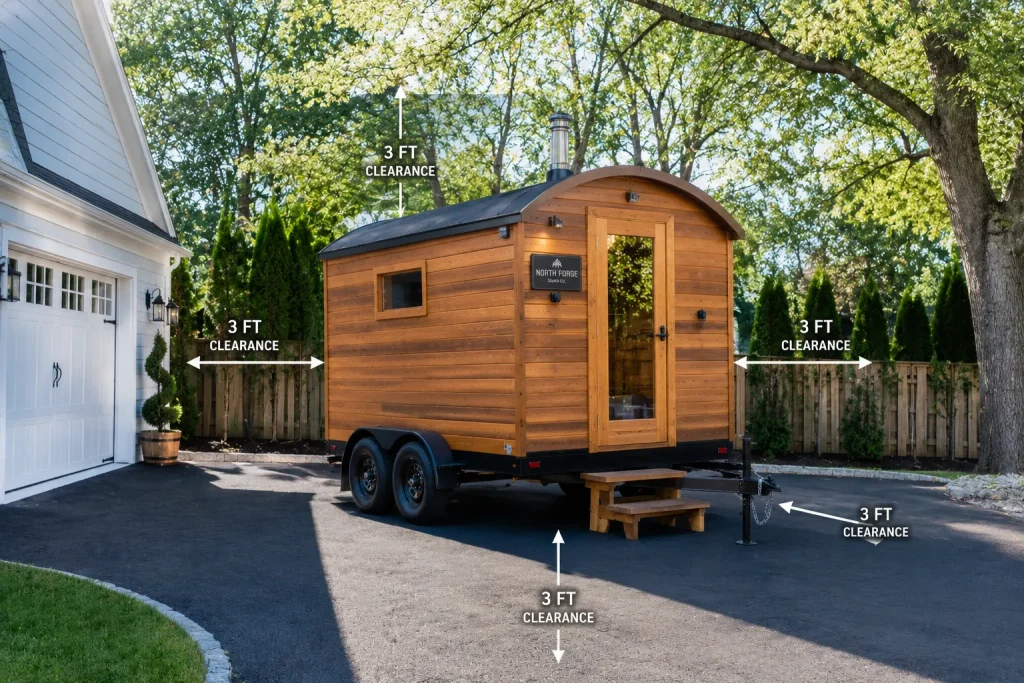
| Side clearance | Around 3 feet on all sides for safe entry, exit, and airflow |
| Distance from structures | Several feet clear of siding, fences, vehicles, and anything flammable |
| Power | Not required for the sauna itself |
| Water | Not required for the sauna itself |
| Tow vehicle room | Space to maneuver in and back out, or a path through |
| Permission | Required if you rent, share a driveway, live under an HOA, or use a venue |
If your driveway or yard clears those numbers, you are almost certainly good to go. The rest of this guide explains why each one matters and how to check it.
Footprint: How Much Ground the Trailer Takes
A mobile sauna sits on a towable trailer, so the space it occupies is the trailer’s footprint plus a little working room at the entrance.
Plan for roughly [20] feet of length and [10] feet of width. The length figure already accounts for the trailer tongue at the front and the step or platform at the rear that you use to climb in. That entry area matters more than people expect, if the back of the trailer is pushed up against a garage door or a fence, there is nowhere to safely step down after a session, which is exactly when balance is worst.
For most Connecticut homes, this means a two-car driveway comfortably fits the unit with room to spare, and a single-car driveway usually works if you are willing to give up parking for the duration of the rental. A flat section of backyard works equally well, provided there is a way to get the trailer back there.
Overhead Clearance: The Requirement People Forget
This is the single most common reason a delivery has to be repositioned, and it is the one nobody thinks to check.
You need at least 12 feet of vertical clearance along the entire route and at the setup spot. That is measured from the ground to the lowest obstruction, and the obstructions that catch people out are rarely obvious:
- Tree branches, particularly maples and oaks that hang low over driveways in older Connecticut neighborhoods
- Utility lines, cable drops, and service wires running from the street to the house
- Garage door frames and carport roofs, which almost never provide enough height
- Roof overhangs, gutters, and porch eaves near the setup spot
- Basketball hoops, string lights, shade sails, and pergolas
A wood-fired sauna also has a chimney flue that extends above the roofline of the unit and runs hot during operation. Even where a branch technically clears the trailer, it may not clear the flue, and hot exhaust under foliage is not something to gamble on. When in doubt, leave more room than you think you need.
Access Path: Getting the Trailer to the Spot
It is not enough for the destination to be big enough. The trailer has to get there.
Aim for at least 10 feet of clear width at every point along the route, and more where there are turns. A trailer does not pivot like a car, it swings wide, and a corner that a pickup truck handles easily can be impossible with something towed behind it.
Check these pinch points specifically:
- Gate openings, which are frequently narrower than the driveway they connect to
- Stone pillars, mailboxes, and decorative posts at the driveway entrance
- Fence corners and retaining walls where the path bends
- Parked cars belonging to neighbors or other household members
- Trash and recycling bins, planters, and landscaping features
- Narrow bridges or culverts on rural properties
If the path narrows anywhere, even for a few feet, that narrow point is your real access width, not the average.
Ground Surface and Level
The trailer needs to sit on ground that is firm enough to hold weight and level enough that the unit sits square.
Surfaces That Work Well
- Asphalt and concrete driveways
- Paver and brick surfaces
- Packed gravel
- Firm compacted dirt and established lawn in dry conditions
Surfaces That Cause Problems
- Soft or waterlogged lawn, where wheels sink and leave ruts
- Loose sand or freshly spread mulch
- Recently poured or resurfaced driveways still curing
- Ground that has thawed and softened after a freeze
As for slope: gentle grade is fine and can be corrected during setup. A steep or heavily banked driveway is a different matter. Towing a loaded trailer up or down a sharp incline is a safety issue for the delivery crew, and a unit that cannot sit level will not drain or operate properly. If your driveway is noticeably steep, flag it before booking rather than on delivery day.
Clearance Around the Unit
Once the trailer is parked, it needs breathing room, for people and for fire safety.
Allow roughly three feet on all sides. That gives enough room to walk around the unit comfortably, to open the door fully, and to step in and out without squeezing past an obstacle in bare feet.
Fire clearance is the more serious consideration and the one most rental guides skip entirely. A wood-fired stove burns real wood and vents through a hot flue that can throw the occasional spark. That means keeping the unit clear of:
- House siding, especially vinyl, which can warp with sustained heat
- Wooden fences and decking
- Parked vehicles
- Woodpiles, dry brush, leaf piles, and stored fuel
- Overhanging foliage of any kind
Open sky above the flue and a few clear feet in every direction is the standard to aim for.
Do You Need Power or Water?
This is one of the most common questions, and the answer is refreshingly simple.
No. A wood-fired mobile sauna runs entirely off-grid. Heat comes from burning wood, not from electricity, so the unit itself needs no outlet, no extension cord, no generator, and no plumbing connection.
The exceptions are add-ons. If your rental includes a cold plunge, exterior lighting, or a sound setup, then a standard household outlet and a water spigot within reach of the setup spot become useful, generally within about a hundred feet. Confirm this when you book if you are adding anything beyond the sauna itself.
Room for the Tow Vehicle
An easily overlooked requirement: the truck that brings the trailer also has to leave.
The delivery vehicle needs either a route through, a circular driveway, a pull-through lot, a second exit, or enough open space to turn around and back out. Backing a trailer down a long, narrow, curved driveway is slow and risky, and on some properties it is simply not possible.
The same applies at pickup, so keep the route clear for both visits, not just the first one.
Where You Can Set Up a Mobile Sauna
| Location | Typically Works? | What to Check |
| Residential driveway | Yes, the most common setup | Overhead wires, low branches, garage overhang |
| Backyard or side yard | Usually | Gate width, ground firmness, turn radius |
| Farm or rural property | Yes | Lane width, gate posts, soft ground after rain |
| Lake house or cabin | Usually | Access road width, seasonal ground conditions |
| Campground or RV site | Often | Site rules on open flame; confirm with management |
| Event venue or brewery | Often | Venue approval, parking layout, insurance requirements |
| Gym, studio, or business lot | Yes | Property owner permission, customer parking impact |
| Apartment or condo complex | Sometimes | Management approval and assigned parking rules |
| Public park or street | Rarely without a permit | Municipal permits are usually required |
| Underground or covered parking | No | Insufficient height and no ventilation for a flue |
Permission: The Requirement That Is Not Physical
Space is only half the question. The other half is permission to put a sauna trailer where you want it.
If You Rent Your Home
Check with your landlord or property manager before booking. Most have no objection to a trailer parked in a driveway for a weekend, but a wood-burning appliance is worth mentioning explicitly rather than assuming.
If You Live Under an HOA
Many Connecticut associations restrict trailers, open flames, or overnight parking of non-passenger vehicles. Rules vary widely, and a quick email to your association saves a difficult conversation later.
If You Share a Driveway
Shared and adjoining driveways are common in older Connecticut neighborhoods. Give your neighbor a heads-up, both about the trailer and about the woodsmoke, which is pleasant but noticeable.
If You Are Booking a Venue or Public Space
Venues, parks, and municipal properties generally require advance approval and sometimes a permit or proof of insurance. Start that conversation early, because approval timelines are rarely fast.
Connecticut Winter: What Changes
Winter is peak season for sauna rentals, and it is also when site conditions matter most.
- Driveways and access paths must be plowed and shoveled before the delivery window. A crew cannot safely position a trailer through unplowed snow.
- Ice on a sloped driveway is a genuine hazard for both the tow vehicle and anyone walking to and from the sauna.
- Ground that was firm in autumn can become soft during a thaw cycle, so a lawn setup that worked in October may not work in March.
- Snowbanks along driveway edges narrow the usable width, sometimes by several feet. Measure the cleared width, not the paved width.
- Have a safe, cleared path from the sauna door to your house. You will be walking it warm and barefoot.
How to Check Your Space in Five Minutes
You do not need a professional assessment. A tape measure and five minutes will answer the question.
- Measure the length and width of the spot where you want the sauna. You are looking for roughly [20] by [10] feet of usable area.
- Walk the route from the street to that spot and find the narrowest point. Measure it. Anything under 10 feet needs a conversation before booking.
- Look up along the whole route. Identify the lowest branch, wire, or overhang and estimate its height. A single-story roofline sits around 10 feet, so anything at or below roof level is a concern.
- Check the ground. Step firmly on it. If it feels soft, sinks, or holds water, choose a firmer spot.
- Assess the slope by eye. Gentle grade is fine. If it feels steep enough that you would notice pushing a loaded wheelbarrow up it, flag it.
- Confirm the exit. Can a truck with a trailer turn around, or is there a way through?
- Take three photos, the setup spot, the access route, and the view looking up, and send them over. A quick look at photos resolves almost every uncertain case in minutes.
What If My Space Does Not Work?
A failed measurement is rarely the end of the conversation. There are usually options.
- Trim the branches. A low limb over a driveway is often the only obstacle, and it is a twenty-minute job.
- Move the vehicles. Clearing the driveway completely can open up both the access width and the turning room.
- Use the front instead of the back. Backyard access is the usual failure point; the driveway almost always works.
- Borrow a better site. A neighbor, family member, or friend with a wider driveway is a common solution, and it makes for a better group session anyway.
- Consider a different location entirely. Farm properties, event venues, and campgrounds all have generous access.
- Come to us instead. If your property genuinely cannot accommodate a trailer, a drop-in session at our Plainville location gives you the same experience without any site requirements at all.
Pre-Delivery Checklist
Run through this the day before your rental.
- Setup area cleared of vehicles, bins, toys, and furniture
- Access route clear from the street to the setup spot
- Low branches trimmed or route confirmed clear
- Ground firm, level, and free of standing water
- In winter: driveway and path plowed, shoveled, and salted
- Flammable materials moved away from the setup area
- Pets secured and children briefed
- Permission confirmed with landlord, HOA, neighbor, or venue
- Someone available on site during the delivery window
- Clear path from the sauna to your door
Frequently Asked Questions
Will a mobile sauna fit in a standard driveway?
In most cases, yes. A typical two-car residential driveway provides more than enough room, and a single-car driveway usually works if it is kept clear. Overhead obstructions cause more problems than driveway size does.
Do I need electricity or water?
Not for the sauna itself, which runs entirely on wood. Add-ons such as a cold plunge or exterior lighting may require a nearby outlet and spigot.
Can it go on grass?
Yes, when the ground is firm and dry. Saturated or thawing ground is a problem, as the wheels can sink and leave ruts.
How much overhead clearance is required?
At least 12 feet, measured along the entire access route as well as at the setup spot. Branches, service wires, and garage door frames are the usual obstacles.
What if my driveway is on a slope?
A gentle grade is manageable. A steep or sharply banked driveway may not be safe for a loaded trailer and should be discussed before booking.
Can I set it up at a park or on the street?
Usually not without a municipal permit. Private property is far simpler, and venues can generally be arranged with advance approval.
Do I need to be there for delivery?
Yes. Someone should be present during the delivery window to confirm placement and receive a brief orientation.
How long does setup take?
Setup and teardown each take well under an hour in most conditions, depending on the site.
Still Not Sure? Send Us a Photo
If anything above left you uncertain, do not guess. Take three quick photos the spot, the route, and the view looking up and send them our way. We will tell you within a few minutes whether it works, and if it does not, we will help you find a setup that does.
We deliver throughout Central Connecticut, with the first 30 miles from Plainville included at no charge.
Ready to book? Check availability and reserve your dates on our booking page.