
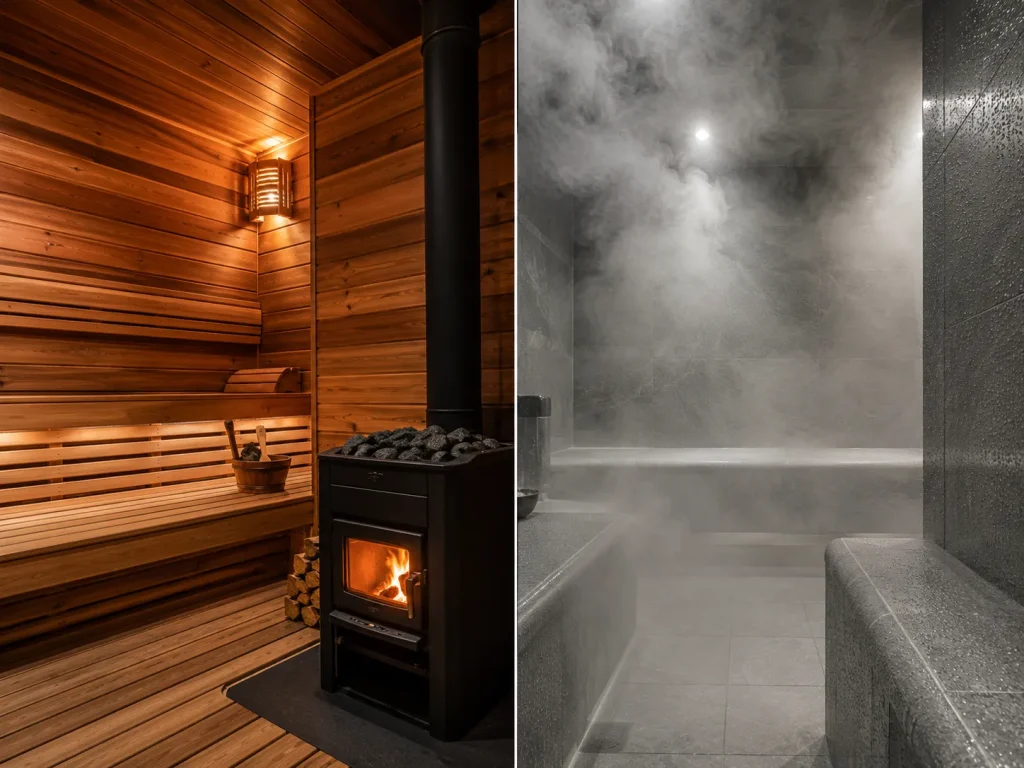
Both rooms are hot. Both make you sweat. Both sit at the back of the same gym, usually behind glass doors a few feet apart. Past that they have almost nothing in common.
Humidity Is the Whole Story
A sauna is hot and dry. Air temperature typically runs somewhere around 150 to 200 degrees F, with humidity down near 10 percent. In a traditional sauna you can raise that briefly by pouring water over hot stones, but it settles back quickly.
A steam room is cooler and saturated. Temperature sits closer to 110 to 120 degrees F, but humidity is held near 100 percent by a generator boiling water into a sealed room.
Everything else follows from those two numbers.
Side by Side
| Sauna | Steam Room |
|---|---|---|
Temperature | About 150 to 200 degrees F | About 110 to 120 degrees F |
Humidity | Around 10 percent | Near 100 percent |
Heat source | Stove and stones | Steam generator |
Materials | Wood lined | Tile, glass or sealed stone |
Typical session | Rounds of 10 to 15 minutes | Single session under 15 minutes |
Feel | Sharp, dry, breathable | Heavy, wet, close |
Research base | Large and long running | Limited |
Can it be portable | Yes | No |
They Feel Nothing Alike
Dry heat is intense but breathable. The air is far hotter, yet you can take a full breath and the heat sits on the skin rather than in the lungs. Most people reach a natural stopping point and step outside.
Wet heat is milder on paper and heavier in practice. Saturated air feels thick, breathing feels shallower, and the lower temperature does not translate into an easier session. Fifteen minutes is a sensible ceiling.
The Sweat in a Steam Room Is Not Entirely Yours
This one surprises people. When the air around you is already holding as much moisture as it can, your sweat has nowhere to evaporate. A good portion of what runs off your skin in a steam room is condensation out of the air rather than fluid your body has produced.
You are still sweating and still losing fluid, which is why hydration matters in both rooms. But the visible drenching is not a measure of how hard your body is working.
What the Research Supports
The evidence is not evenly split. Long running population studies on regular dry sauna bathing, most of them out of Finland, have linked frequent use with lower rates of cardiovascular disease and mortality. Those are observational findings, so they show association rather than proven cause, and they should be read that way. Even so, the body of work is substantial.
Steam rooms have far less behind them. Most heat therapy research studies dry saunas, and the moist heat literature is thin by comparison. The one area where steam has a clear practical edge is the airways. Warm moist air loosens congestion, which is why people reach for steam during a cold or with sinus trouble.
Sweating Is Not Detoxification
You will see this claim on university pages and retailer pages alike. Sweating is temperature control. The liver and kidneys clear waste from the blood, and they do that job regardless. Sweat is water and electrolytes with only traces of anything else.
There are well supported reasons to use either room. This is not one of them.
One of These You Can Actually Own
Here is the practical difference no comparison article seems to mention.
A steam room is a building project. It needs a fully sealed enclosure, a generator sized to the space, a plumbed water feed, a drain, a dedicated electrical circuit, full waterproofing and usually permits. Wood is not an option inside one, because it warps, splits and grows mold at full humidity, so the room has to be tile, glass or sealed stone. A home installation commonly lands somewhere in the low to mid four figures before anything goes wrong.
A sauna has no such constraints. It can be a wood lined room, a freestanding cabin, or a trailer mounted unit that arrives, gets used for a weekend and leaves. Fire it with wood and it needs no electricity, no plumbing and no permit for a temporary setup.
So the honest version of the question is not which room is better for you. It is which room you can realistically use. For most people a steam room means going to a gym or a spa on their schedule. A sauna can come to the driveway.
Hygiene Works Differently
Warm wet surfaces in a shared facility are a different proposition from a hot dry bench. Steam rooms hold moisture on every surface, and shared ones can carry other people’s bacteria. Sit on a towel, rinse before and after, and treat a busy public steam room accordingly.
Dry heat is less hospitable to that problem, and a private sauna removes it altogether.
Choosing Between Them
If you want | Better fit |
|---|---|
Relief from congestion or sinus pressure | Steam room |
Gentler air temperature | Steam room |
The strongest research base | Sauna |
To pair heat with a cold plunge | Sauna |
A private session with a group | Sauna |
Something you can have at home without a build | Sauna |
Something that works with no power at all | Wood fired sauna |
Before You Use Either
- Drink water before and after. Both cause real fluid loss.
- Keep steam room sessions under about 15 minutes.
- Step out at the first sign of dizziness or nausea.
- Skip both after drinking alcohol.
- If you are pregnant, have a heart condition or low blood pressure, or take medication affecting heat tolerance, speak to a doctor first.
The Short Answer
Choose a steam room for congestion and for gentler air. Choose a sauna for the research, for the cold water pairing, for a group, and for the fact that you can put one in your own yard for a weekend without calling a plumber.