Most comparisons of these two end in a shrug. That is usually because the company writing them sells both.
We only run traditional wood-fired saunas, so we have an obvious bias and it is better to say so up front. What follows is an honest account of how the two differ, what the research supports, and where infrared is genuinely the better choice, because for some people it is.
The Core Difference
Everything else follows from one thing: what gets heated first.
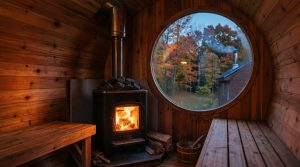
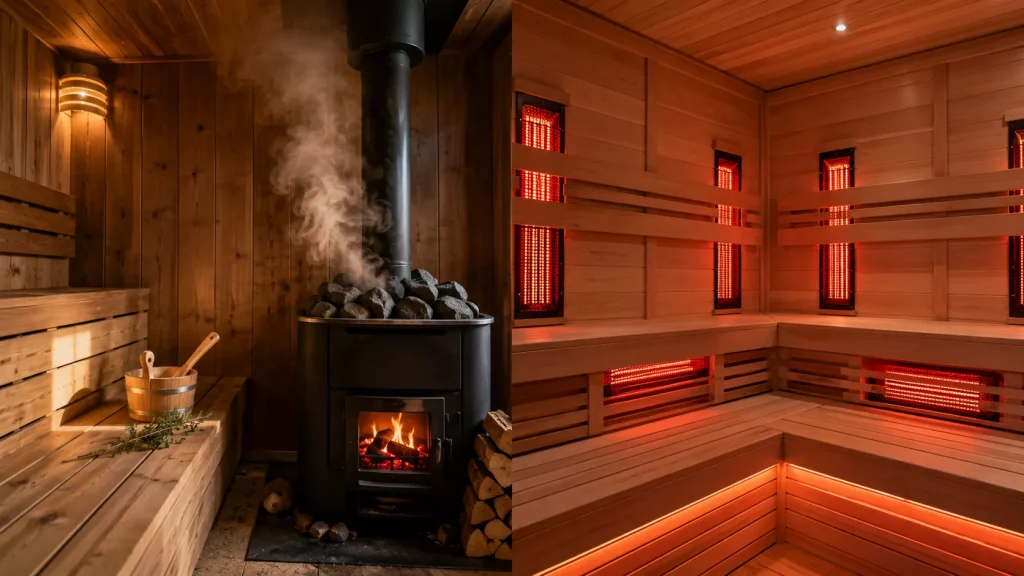
A traditional sauna heats the room. A stove full of stones warms the air, the air warms the benches and walls, and you heat up because you are sitting in a hot room surrounded by hot surfaces. Physically, your body is warmed by contact with hot air, by air circulating around you, and by radiation from every heated surface in the room.
An infrared sauna heats you. Panels emit infrared light that is absorbed at the surface of your skin. The air in the cabin stays comparatively cool, because warming the air was never the point. Almost all of the heating happens through radiation alone.
That single distinction produces every other difference, temperature, feel, steam, session length, and who each one suits.
Side by Side
| Traditional | Infrared |
|---|---|---|
What heats up | The air and the room | Your skin, directly |
Typical temperature | Roughly 150 to 195 degrees F | Roughly 110 to 150 degrees F |
Heat source | Stove and stones, wood, electric, or gas | Infrared panels or lamps |
Steam possible? | Yes, water poured on hot stones | No |
Humidity | Adjustable, from dry to very humid | Consistently dry |
Typical session | Shorter, often in rounds | Longer, at lower intensity |
Typical capacity | Communal, benches for several people | Usually one or two people |
Feel | Enveloping, intense, sharp on the skin | Gentle, gradual, sun-like |
Research base | Extensive, including long-term population studies | Smaller and earlier-stage |
Off-grid capable | Yes, with a wood stove | No, requires electricity |
How Each One Feels
Temperatures on a chart tell you almost nothing about the experience, so here is the part most articles leave out.
A traditional sauna feels like weather. You open the door and heat pushes against you. Your skin responds immediately, breathing feels different, and there is a distinct point at which you have had enough and step outside. That threshold is part of the appeal, the contrast between inside and outside is sharp, and the relief of cool air afterward is a large part of why people keep going back.
An infrared cabin feels like strong sunlight. The air is not oppressive, the onset is gradual, and you can sit comfortably for a long time reading or listening to something. Many people find it more tolerable, and for anyone who has tried a traditional sauna and found it overwhelming, that tolerability is the entire argument.
Neither sensation is superior. They are genuinely different experiences that happen to share a name.
Steam: The Difference Nobody Emphasizes Enough
In a traditional sauna you can ladle water onto the hot stones. The Finnish word for the resulting burst of steam is loyly, and it is not a minor feature, it is the center of the practice. The room fills with a wave of humid heat, the sensation on the skin changes completely, and you can adjust the intensity of your own session, round by round, simply by how much water you use.
An infrared cabin cannot do this. There are no stones and no meaningful air heat to carry moisture. Whatever else infrared offers, this specific experience is not available in it.
For anyone drawn to sauna as a tradition and a ritual rather than as a wellness appliance, this is usually where the decision gets made. It is also why Finnish sauna organizations have historically been reluctant to classify infrared cabins as saunas at all, a debate worth knowing about, even if it matters little to how you feel afterward.
What the Research Actually Shows
This section deserves care, because it is where most articles either overclaim or go vague.
Traditional Saunas
The strongest long-term evidence in the entire field comes from traditional Finnish-style bathing, largely because Finland has population-scale sauna use going back generations and researchers have been able to follow large groups over long periods. Those studies have associated frequent sauna bathing with lower rates of cardiovascular disease, dementia, and all-cause mortality.
The important caveat: these are observational studies. They show association, not proof of cause. People who use a sauna several times a week may differ from people who do not in ways that are difficult to fully account for. The findings are consistent and taken seriously, but they are not the same as a controlled trial.
Infrared Saunas
The infrared evidence base is smaller and younger. Early research, including work on infrared and related heat therapies, has reported effects on blood pressure, heart function, chronic pain, and fatigue in specific patient groups. Some of it is promising. It is also preliminary, often involves small samples, and does not yet support the sweeping claims made in a good deal of infrared marketing.
What Both Share
Both raise heart rate, increase circulation, and produce heavy sweating. Both are widely used for relaxation, recovery, and stress. And the most practical conclusion in the literature is the least dramatic one: the sauna that benefits you most is the one you will actually use regularly. Consistency outweighs the choice of category.
A Word About “Detox”
You will see it claimed, on both sides of this comparison, that sweating detoxifies the body.
Sweating is thermoregulation. It is how the body sheds heat. The organs that clear waste from your blood are the liver and the kidneys, and they do that job with or without sweating. Sweat contains water and electrolytes with only trace amounts of anything else.
There are good, well-supported reasons to use a sauna. Detoxification is not one of them, and any company leaning on it is selling rather than informing.
The Social Difference
This one settles the question for a lot of people and almost nobody mentions it.
Infrared cabins are usually built for one or two people. They are private by design, a solitary session, often with a book or a podcast.
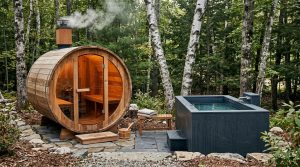
Traditional saunas are communal. Benches, tiered seating, several people at once, conversation and rounds. In Finland the sauna is a social institution before it is a health one, and much of what people value about it is the shared part.
So the practical question is often not which heats better, but how you want to use it: alone, or with other people. If the answer involves friends, a group trip, or an event, the category is already decided.
Session Length and Rhythm
Lower temperatures change how a session is structured.
- Infrared sessions tend to be single, longer, and steady, comfortable enough to stay put for an extended stretch.
- Traditional sessions tend to run in rounds, a shorter spell in the heat, a cool-down outside, then back in. The cycle is the practice.
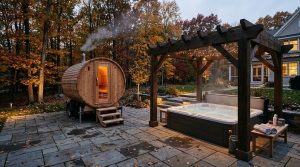
- The cool-down is far more meaningful in a traditional sauna, which is why cold plunges, cold showers, and lake swims are paired with it and rarely with infrared.
Which Should You Choose?
If you want… | Better fit |
|---|---|
A private, low-intensity session you can extend | Infrared |
Something gentler if intense heat is uncomfortable for you | Infrared |
A compact unit that fits indoors in a small space | Infrared |
Steam, and the ability to control intensity yourself | Traditional |
A social experience with a group | Traditional |
The strongest long-term research base | Traditional |
Sauna as a tradition rather than an appliance | Traditional |
Something that works with no electricity at all | Traditional, wood-fired |
To pair heat with cold water immersion | Traditional |
Within the traditional category there is a further choice between wood-fired and electric heating, which changes the character of a session considerably. That is a separate question and we cover it separately.
Before You Use Either
The same precautions apply to both types.
- Hydrate before and after. Both produce substantial fluid loss.
- Do not use either after drinking alcohol.
- Step out if you feel dizzy, nauseated, or unwell. This is not an endurance activity.
- Start with shorter sessions if you are new to heat exposure.
- If you are pregnant, have a heart condition, have low blood pressure, or take medication that affects how your body handles heat, speak with your doctor first. This applies to both categories, the lower temperature of infrared does not remove the need to ask.
Frequently Asked Questions
Is an infrared sauna a real sauna?
It depends who you ask. It is a heat therapy cabin that produces sweating and has documented effects. Its standing as a sauna in the traditional sense is contested, and Finnish sauna bodies have generally said no, largely because there is no steam and no stones.
Which one gets you sweating faster?
Traditional, because the air itself is far hotter. Infrared brings on sweating more gradually.
Is infrared safer because it is cooler?
Not automatically. Lower air temperature makes it more tolerable, but dehydration, overheating, and the same medical cautions still apply.
Can you pour water in an infrared sauna?
No. There are no heated stones and no air heat to carry the steam.
Which has better health research?
Traditional, by a wide margin, chiefly long-term Finnish population studies. Those studies are observational, so they show association rather than proven cause.
Which is better for a group?
Traditional. Infrared cabins are generally built for one or two people.
Does a wood-fired sauna count as traditional?
Yes. Wood, electric, and gas are all ways of heating a traditional sauna. Wood-fired is the oldest of them and the only one that works without electricity.
Can I try a traditional sauna before buying anything?
Yes, and it is the sensible order of operations. Reading about heat is a poor substitute for sitting in it.
The Honest Recommendation
If intense heat is uncomfortable for you, if you want a private session you can stretch out, or if you need something compact indoors, infrared is a reasonable and legitimate choice.
If you want steam, the ability to control your own intensity, a shared experience, the strongest evidence base, and the version of this practice people have been doing for a thousand years, that is a traditional sauna.
The best way to settle it is not to read more comparisons. It is to sit in a proper wood-fired sauna once, pour water on the stones, step outside into cold air, and notice what your own reaction is. Most people find they already knew the answer.
We deliver traditional wood-fired saunas across Central Connecticut, and we run drop-in sessions if you would rather try one before committing to anything at all.