
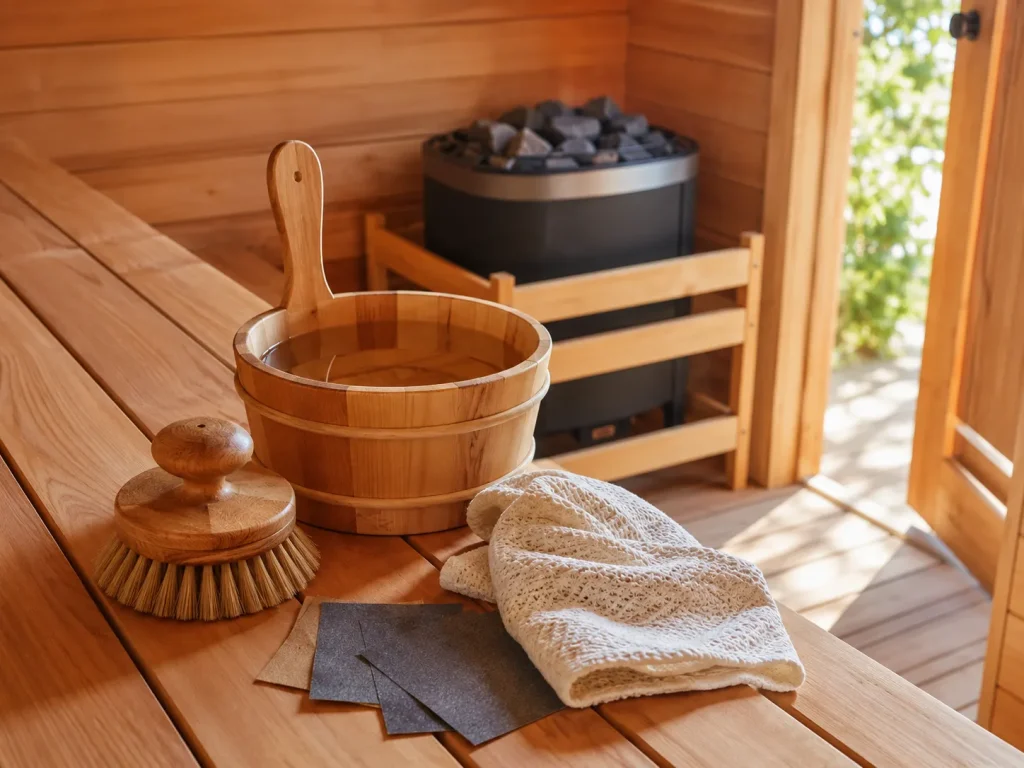
Start with the rule that matters more than every technique below it: do not put bleach, disinfectant spray, strong detergent or any sealant on the interior wood of a sauna.
Sauna benches and walls are left unsealed deliberately, so the wood is porous and it absorbs whatever you apply. Then you heat the room to 190 degrees Fahrenheit, which drives that residue back out as vapour into a small enclosed space, and you sit in it and breathe deeply for twenty minutes. It is not a finish problem, it is a lungs problem, and it is the reason sauna cleaning advice looks so minimal compared with cleaning anything else.
The routine
| How often | What to do | Why |
| After every session | Prop the door open, let it dry | Drying is most of the cleaning |
| Weekly, or after heavy use | Wipe benches with water, mild soap only if needed | Rinse and dry fully |
| Monthly | Sweep and wash the floor and duckboards | This is where the actual risk lives |
| Yearly | Light sand of the benches with fine grit | Removes sweat-stained surface wood |
| Every one to two years | Check and replace cracked stones | Crumbled stones choke airflow and ruin loyly |
That is the whole job. Most of it is drying rather than scrubbing. Scale the cadence to use: a unit fired twice a week needs the weekly line, one used daily needs it after every second session, so how often the room actually gets used sets the schedule more than the calendar does.
Ventilation is the actual cleaning
The single most effective thing you can do is prop the door open after a session and let the room dry out completely. Some people run the heater for another ten or fifteen minutes with the door ajar to drive the moisture out faster.
Damp wood at room temperature is where anything unpleasant grows. Dry wood is inert. A sauna that is dried properly after each use needs very little else done to it, and a sauna that is closed up wet will develop a smell within a couple of weeks no matter how much you scrub it.
Can bacteria grow in a dry sauna
Google surfaces this one directly, and it deserves a straight answer. During a session, no, not meaningfully. High heat and low humidity are a hostile combination for microbial growth, and the upper benches are the most hostile part of the room.
The risk is not the bench, it is the floor. Floors, duckboards and the corners where water pools stay cool and wet and never reach the temperatures the benches do. If you are worried about picking something up in a sauna, feet are the honest concern, which is also why footwear in the shower area and a rinse before entering are worth bothering with. Wooden duckboards should come out to dry rather than sitting on a wet floor.
Should you wipe sweat off
The second of the two good questions Google raises here, and it splits in two. For the room: yes, sit on a towel so that your sweat goes into cloth rather than into the bench, and wipe the bench down before you leave. That is basic shared sauna courtesy and it is also the main thing that keeps benches from staining.
For your body: leave it. Wiping sweat off your skin removes the layer that is doing the cooling, which makes the room feel hotter, not cleaner. In a dry sauna the sweat evaporating is the mechanism by which you tolerate the heat at all. Bringing a towel to sit on is covered in our notes on what to take into a sauna.
The stones nobody replaces
This is the maintenance job that gets skipped, because stones look permanent and are not.
Sauna stones go through violent thermal cycling, heated to several hundred degrees and then hit with cold water, over and over. They crack and eventually crumble. The fragments settle into the gaps and choke the airflow through the stack, which is what a stove depends on.
A stove with degraded stones takes longer to heat, holds heat badly and gives poor loyly, and owners usually blame the heater. Pull the stones out once a year, discard anything cracked or crumbling, wash the rest and restack them loosely so air can move. Loose is the key word. For heavy use, expect to replace them every year or two. The relationship between stone mass and heat quality is covered in our guide to sauna temperatures, and it matters more than the number on the thermostat. Wood-burning stoves also need the firebox and flue cleared of ash and creosote, which electric units do not, and the differences between the two heat sources extend to what you have to maintain.
Stains, smells and sanding
Sweat stains on benches are normal and they are surface deep. Once a year, a light sand with fine grit takes the top layer off and the bench comes back looking new. That is the correct fix, and it is why you must not seal the wood: a sealed bench cannot be sanded back, traps moisture underneath, and gets hot enough to be unpleasant to sit on because the finish conducts heat where bare timber does not.
For a persistent smell, the answer is almost always more drying rather than more cleaning. Run the room hot and empty with the vents open. If that does not fix it, check under the duckboards and behind the heater, which is where water collects and nobody looks.
Exterior wood on an outdoor unit is a separate matter and does get treated, since it faces rain and freeze-thaw rather than your lungs. Interior and exterior are opposite problems and the products for one should never be used on the other.
A brief note on the toxins question
People searching for sauna cleaning also ask if saunas remove toxins from the body. Briefly: sweating is a temperature regulation mechanism, not an excretion route of any significance. Your liver and kidneys do that job. There are real reasons to use a sauna and this is not one of them, which is worth knowing before you buy anything sold on that basis, and what you actually lose in a session covers it properly.
If you would rather not own the maintenance
Everything above is perhaps twenty minutes a week plus an afternoon once a year, which is not onerous but is not nothing either, and it is the part of ownership that nobody factors in when they are looking at prices. It is one of the quieter arguments in the case for renting rather than buying: a delivered unit arrives clean and leaves with the cleaning as somebody elses problem. If you want to see what that looks like in practice, a session is the simplest way to find out.