
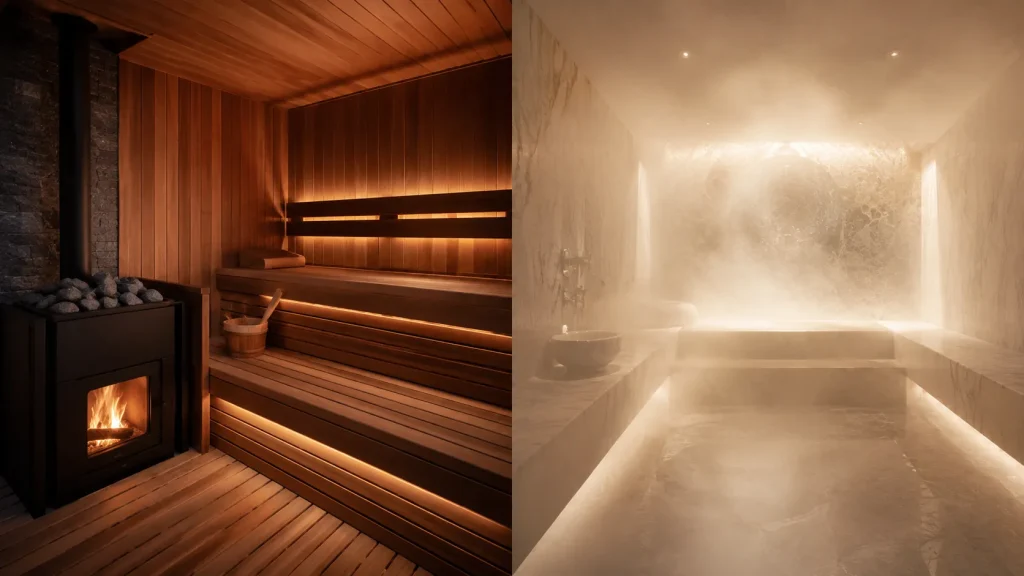
Ask most people which one makes them sweat more and they will say the steam room without hesitating. They walk out of it dripping. The sauna leaves them warm and damp. The evidence of their own skin seems clear.
That impression is wrong, and the reason it is wrong turns out to be the most useful thing to understand about this comparison.
The sweat you see in a steam room is not all yours
A traditional sauna runs somewhere between 70 and 100 degrees Celsius with humidity in the range of 5 to 20 percent. A steam room runs much cooler, usually 40 to 45 degrees, with humidity at or near 100 percent.
That humidity difference changes what happens to your sweat.
In a sauna, the dry air pulls moisture off your skin almost as fast as you produce it. Evaporation is how sweating actually cools you, so the system works as designed. You stay relatively dry-looking even while losing a good deal of fluid.
In a steam room, the air is already saturated. It cannot absorb any more water, so your sweat has nowhere to go. It sits on your skin and runs off you. On top of that, the steam itself condenses on your body, because your skin is cooler than the vapor around you.
So the water streaming off you in a steam room is a mixture of your sweat and the room’s condensation, and you have no way to tell the proportions. You look like you sweated more. You may well have sweated less.
A quick way to test this on yourself: step out of a steam room and stand in the changing area for a minute without toweling off. A good deal of what is on you will not behave like sweat, because it is not. Do the same after a sauna and there is far less on your skin, even though you may have lost more fluid overall.
Which one actually removes more water
Over the same session length, a traditional sauna usually removes more fluid, because the air temperature is roughly twice as high and evaporation is working.
The honest caveat is that individual figures vary widely with body size, session length, how hot the room is actually running, and how acclimated the person is. Anyone who publishes a precise number for this is guessing.
More to the point, it does not matter. Fluid loss is not fat loss, and the amount of water you shed says nothing about your body composition. There is a fuller explanation of where fat actually goes when you lose it, and it does not involve your skin.
Why the humidity makes a steam room harder, not easier
Here is the part that surprises people. Because evaporation is blocked, your body’s main cooling mechanism stops working in a steam room. It keeps producing sweat and gets no cooling benefit from it.
That means heat strain builds at a much lower air temperature than it would in a sauna. Forty-five degrees in saturated air can feel harder to sit in than ninety degrees in dry air, and it can raise your core temperature efficiently despite the milder reading on the thermometer.
The practical consequence is that a steam room deserves the same caution as a sauna, not less, even though the number on the wall looks tame. Anyone with a heart condition, blood pressure issue, or who is pregnant should read who should avoid heat exposure before using either.
Temperature ranges and what each format is capable of
The gap between the two is wider than most people assume. Traditional Finnish saunas are typically set somewhere in the eighties or nineties Celsius. Steam rooms cannot go much past the mid forties, because saturated air at higher temperatures becomes genuinely dangerous to breathe.
That ceiling is a design constraint, not a preference. It also means the two formats are not adjustable into each other. You cannot turn a steam room up to sauna heat, and adding water to sauna rocks raises humidity briefly without turning it into a steam room. The temperature range for each format explains where the practical limits sit.
For the weight question, the ceiling matters only in that it caps how much fluid a steam room can move. It does not create a metabolic difference worth acting on.
The calorie side of it
Both rooms raise your metabolic rate modestly through thermoregulation. Neither raises it into exercise territory.
The full breakdown of how many calories a sauna burns applies to a steam room too, with the same order of magnitude. You are looking at something in the region of a light walk for a half-hour session, and only a fraction of that is above what you would have burned sitting on a couch.
There is no version of this comparison where one room is a weight loss tool and the other is not. They are two ways of doing the same modest thing.
Two questions that come with this one
People searching this comparison usually arrive with a second question attached, and both deserve a straight answer.
The first is about belly fat. Neither room reduces it, and neither reduces fat anywhere else specifically. Spot reduction does not work through heat any more than it works through crunches. Abdominal fat responds to an overall energy deficit and to nothing you can apply from the outside.
The second is about how many calories a thirty-minute steam room session burns. The answer sits in the same range as a sauna, roughly fifty to a hundred gross for most adults, with only twenty to forty of those above what the body would have spent anyway. If a page quotes you three or four hundred, it is either reporting an intense multi-round research protocol or making it up.
What the research says about the outcome
The comparison also collapses when you look at what happens over time rather than in one session.
Researchers have tracked people through a month of regular sauna sessions with medical imaging and controlled diets, and found no change in fat mass. There is no equivalent body of work suggesting steam rooms perform differently, and no mechanism by which they would, since the physiology is the same in both. The longer answer on what heat does for weight loss covers the trial data.
If someone tells you a steam room burns fat that a sauna does not, or the reverse, ask what they are selling.
The wrestling forum question
Search this topic and you will find threads asking which room is better for cutting weight before a competition weigh-in. Those threads are where a lot of the sauna versus steam room folklore came from.
Weight cutting is deliberate dehydration on a planned day, followed by rehydration afterward. It exists because of weight classes, it is done by people under supervision with something specific at stake, and it changes nothing about body composition. Every pound goes back on before competition.
It is not a method to copy for general weight loss, and comparing the two rooms on that basis is comparing them on something that does not apply to almost anyone reading this.
Choosing between them for reasons that hold up
Since neither one wins on weight, the choice comes down to what you actually want from the heat. The full sauna and steam room comparison covers that ground properly, but the short version is worth having here.
A sauna suits people who want higher heat, a drier environment, and longer sessions. It is the format used in most recovery research, and the one people tend to build a lasting habit around.
A steam room suits people who find dry heat uncomfortable on the airways, or who want the moisture for congestion or skin reasons. It is gentler on the throat and nose.
Neither is more effective than the other for fat. Pick the one you will actually use, since consistency is what produces any of the real benefits.
Something to skip either way
Sauna suits get marketed alongside both of these, and they work on the same misunderstanding this whole comparison rests on: that visible sweat equals progress.
Wearing plastic in a hot room increases how wet you get and blocks evaporation at the same time, which combines the discomfort of a steam room with the temperature of a sauna and delivers nothing extra for it.
The bottom line
A steam room makes you look like you sweated more because sweat cannot evaporate and steam condenses on your skin. A sauna usually removes more actual fluid.
Neither difference matters, because fluid is not fat and it returns the moment you drink.
If you are choosing a format for recovery rather than for the scale, that is a better question, and comparing a gym membership against a private session at home is a more useful place to spend the decision. Both rooms do roughly the same thing. Neither one is the reason anyone loses weight.