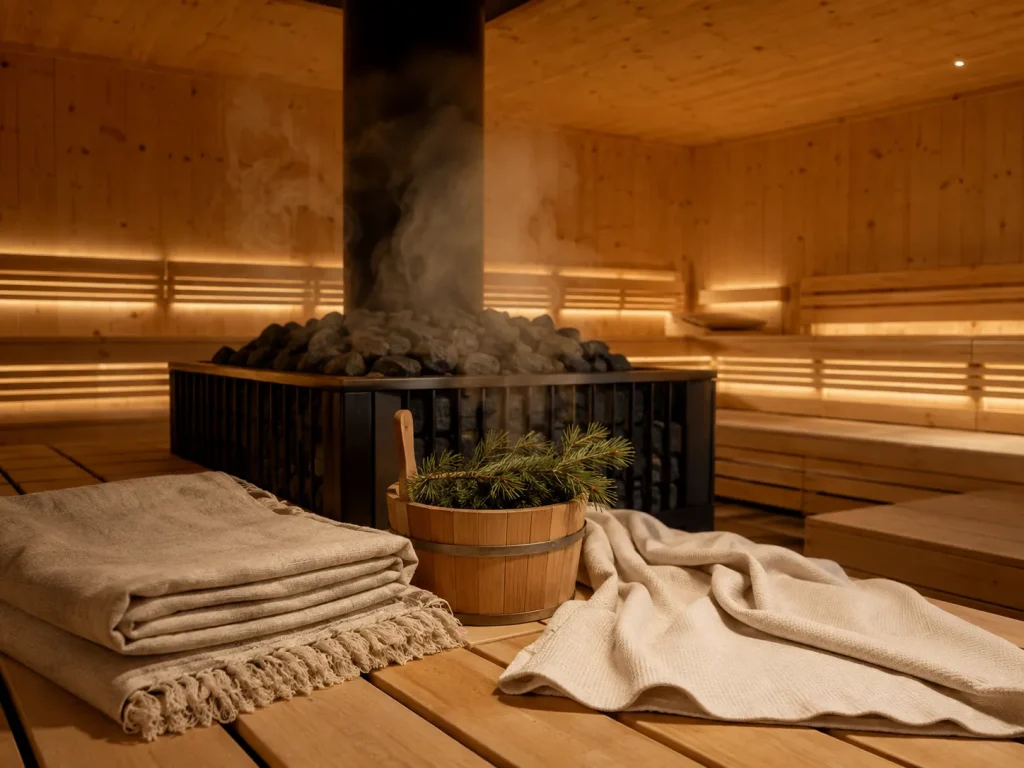
A German sauna is hotter than most Americans expect, stricter about behavior than anywhere else in Europe, and textile-free without exception. It also has a ritual that Finland does not: Aufguss, run by a trained sauna master on a schedule posted at the door.
If you are going to one, the three things you need to know are that you will be naked, that you will be quiet, and that if you turn up mid-Aufguss you will not be let in. Everything else follows from those.
Yes, you will be naked
This is the question underneath most searches on the subject, so here it is answered plainly. German saunas are textile-free. Swimwear is not modest in a German sauna, it is unhygienic and against the rules, because synthetic fabric holds sweat and bacteria and releases them into a shared room. Staff will ask you to remove it.
You carry a large towel and you sit or lie on it, so that no part of you touches the wood directly. That is the actual hygiene rule and it is enforced far more seriously than any modesty rule. You wear a robe and sandals between rooms and take them off at the door.
Most facilities are mixed-gender by default, with some running women-only days. The atmosphere is notably matter-of-fact and nobody is looking at anybody. Foreign visitors consistently report that the awkwardness lasts about twenty minutes and then stops mattering.
Conventions outside Germany are different, and if you are heading to a sauna here rather than there, our guidance on what to wear covers what is normal in American settings, which is not the same thing at all.
It is hotter, and quieter
German rooms commonly run at 90 to 100 degrees Celsius, which is 194 to 212 degrees Fahrenheit. That is at the top of the range you would meet in Finland and well above a typical American gym sauna.
The silence is the other adjustment. Conversation in a German sauna is either absent or conducted in a near whisper, and a normal speaking voice will earn you looks. Phones are banned outright, not discouraged. For the general courtesies that carry across most countries, our notes on sauna etiquette cover the basics, and our guide to temperatures by sauna type puts the German figures against everything else.
Aufguss is the thing worth traveling for
The word means infusion, and it is the ceremony that defines German sauna culture. A trained Saunameister runs it to a timetable, and the room fills before it starts because latecomers are not admitted once the door closes.
There are three actions. The sauna master pours scented water, or places scented ice balls, onto the hot stones. Then comes the wedeln: the towel is swung, whipped and spun overhead in choreographed patterns to drive the heat around the room and onto each person in turn. At the end, the room applauds, which also serves as the signal that you may leave.
A session usually runs ten to fifteen minutes across three rounds, each building in intensity.
Round | Length | What happens |
|---|---|---|
Round 1 | 3 to 5 minutes | Lightest scent, gentlest waving, room settles |
Round 2 | 3 to 5 minutes | Heat builds, towel work becomes faster |
Round 3 | 3 to 5 minutes | Hottest, most intense, applause at the end |
The named towel techniques have a showmanship to them, with moves called the Helikopter and the Pizza, and there are competitive Aufguss championships where sauna masters are judged on choreography, scent selection and music. It is closer to a performance than to anything in Finnish practice. If you want to know how long a heat exposure should sensibly last, note that three rounds of five minutes with the heat climbing is a real load despite sounding short.
Why the towel makes it so much hotter
This is the part nobody explains, and it is the most interesting thing about the whole practice. During an Aufguss the air temperature barely changes. The steam from the ladle adds a little, but nothing like enough to account for how much more intense it feels.
What the towel is actually doing is stripping away the boundary layer. Sitting still in hot air, your body warms a thin film of air right against your skin, and that film becomes slightly cooler and much more humid than the room, because it is full of your own evaporated sweat. It sits there and insulates you. It is the reason you can tolerate a still sauna at all.
Waving the towel tears that film off and replaces it with fresh hot air, over and over. Heat transfer to your skin accelerates sharply while the thermometer on the wall does not move. It is the same mechanism that makes a steam room feel punishing at a much lower temperature, running in reverse: steam prevents your sweat evaporating, Aufguss prevents the evaporated layer from staying put. The comparison of dry heat and steam works through the other half of that.
It started as a chore
The romantic version has Aufguss as an old ceremonial tradition. It is not. A closed sauna gradually runs low on fresh air, and the room needs periodically re-oxygenating and re-mixing or it goes stale and the heat stratifies into layers.
Somebody worked out that opening the door, pouring water on the stones and swinging a towel around was the fastest way to restore both the air quality and the even temperature. The ceremony grew on top of a maintenance task. The scents, the music and the championships all came later, attached to something that was originally just the most efficient way to sort out a stuffy room.
How a visit runs
Shower before you enter, every time, and dry off. Take your large towel and lay it out so nothing touches the wood. Sit for eight to fifteen minutes, or stay for a full Aufguss if one is scheduled.
Then cool down properly, and this is not optional in German practice any more than in Finnish. Cold plunge or a cold hose, then fresh air, then rest for as long as you were in the heat. The rest stage is where most of the effect lands, and skipping it to get back in is the most common mistake foreign visitors make. Our page on what alternating heat and cold actually does covers the physiology. Two or three full rounds is a normal visit.
Mobile and traveling saunas have a longer German and Nordic history than most people assume, and the background on saunas that move runs further back than the current trend suggests.
Getting some of it here
You will not find a Saunameister on a schedule in most of New England. What travels well is the underlying idea, which is that a sauna session is better when somebody is running it: heat managed deliberately, water on the stones at the right moment, rounds with a beginning and an end, and proper cooling in between.
A wood-fired room with a decent stone load will take an infusion well, and the towel technique is not a secret. Get the room hot, ladle scented water onto the stones, and move the air with a large towel in rounds. If you want to try that without flying to Cologne, a private session gives you a room where you can run it properly, and a rundown of how a delivered session works covers the practical side. It suits a group better than a solo visit, since somebody has to run it, which is why a weekend booking gives you enough sessions to get the technique right rather than one nervous attempt.