
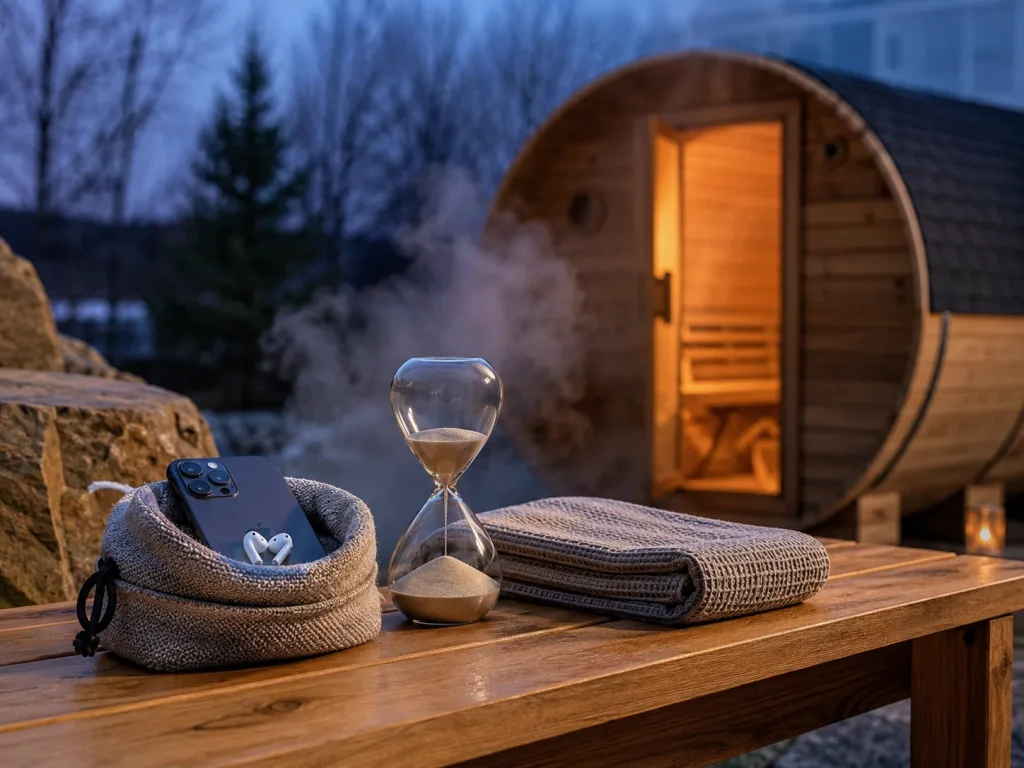
You can, in the sense that nothing will stop you and the phone will probably still work when you come out. You should not, and the reason is more specific than “heat is bad for electronics”.
The manufacturers publish the numbers. Almost nobody writing about this looks them up.
What the manufacturer actually specifies
Apple states the acceptable conditions for an iPhone plainly in its support documentation. Android makers publish comparable figures. Here is that specification set against what a sauna is actually doing.
Specification | Figure | What it means |
|---|---|---|
Apple operating range | 32 to 95 degrees F | The device is designed to be used in this band |
Apple storage range | minus 4 to 113 degrees F | The limit even when switched off |
Apple humidity spec | 5 to 95 percent, noncondensing | The last word is the one that matters |
A traditional sauna | 175 to 195 degrees F | Roughly 80 degrees past the storage limit |
An infrared cabin | 120 to 150 degrees F | Still above the operating limit |
Read the second row again. Minus 4 to 113 degrees Fahrenheit is the range for storage, meaning the phone is switched off and doing nothing. A traditional sauna sits roughly 80 degrees Fahrenheit above the top of that range, and it stays there for the length of your session.
Apple also says directly that using the device in very hot conditions can permanently shorten battery life. Not temporarily. That word is doing a lot of work and it is the whole argument. For the temperatures each type of room actually runs at, our breakdown of sauna temperatures by format has the figures.
Why “I have done it for years and it is fine” is wrong
This is the most common response you will find in any forum thread on the subject, and the people saying it are being honest. Their phones did come out working. The problem is that they are measuring the wrong thing.
Heat damage to a lithium-ion battery is cumulative, permanent and invisible on the day. Every session at high temperature causes a small, irreversible loss of maximum capacity. The phone does not fail, it just holds slightly less charge than it did, and the loss stacks.
Six months later the owner notices the battery does not last the way it used to, and attributes it to the phone getting old, or to a software update, or to the battery simply being a year further on. None of those get connected back to twenty minutes at 190 degrees twice a week, because the connection is invisible and slow. That is why the anecdotal evidence on this question is systematically misleading. Everyone reports on the survival of the session. Nobody reports on the capacity curve.
The condensation problem is the bigger one
Look again at the humidity specification: 5 to 95 percent, noncondensing. That final word is the one that matters, and it is the difference between damp air and water forming on a surface.
Here is the sequence that actually destroys phones around saunas. The device sits in a hot, humid room and warms all the way through, including the air inside the case. Humid air works its way in through the speaker grilles and ports, which are not sealed against vapor. Then you step outside into cold air, or into the area where the cold plunge is, and the phone cools quickly from the outside in. The moisture already inside it condenses into liquid water against cold internal surfaces, and it does so where you cannot see it or dry it.
A Connecticut winter makes this dramatically worse, because the temperature difference between the sauna and the yard can exceed 150 degrees. If you are running a heat and cold cycle, and alternating between the two is the point of the practice, you are performing exactly the sequence that drives condensation inside the device. A steam room is worse again for the same reason, and the difference in humidity between the two rooms is substantial.
Water resistance will not save you
People reasonably assume an IP68 rating covers this. It does not, and the gap is worth understanding.
Those ratings are established by immersion testing in fresh water at ordinary temperature and a specified depth for a specified time. They are not tests of hot vapor, and vapor behaves differently: it penetrates gaps that liquid water bridges over. On top of that, the seals themselves are adhesives and gaskets that soften as they heat, so the resistance you are relying on is at its weakest at the exact moment you are relying on it.
Worth knowing as well that liquid damage is generally excluded from the standard warranty, and phones carry internal moisture indicators that a technician checks. A device damaged this way is usually not a warranty repair.
Is an infrared sauna different
Somewhat, and it is fair to separate them. An infrared cabin typically runs 120 to 150 degrees Fahrenheit rather than 175 to 195. That is meaningfully cooler and it sits below the 113 degree storage limit at the very bottom of its range, though still comfortably above the 95 degree operating limit.
So an infrared session is less punishing than a traditional one. It is not harmless, and the humidity is lower but not zero. If you want the full picture on how the two heat you differently, the comparison of infrared and traditional heating covers it. The practical answer does not change much: cooler than terrible is still not good.
The other reason gyms ban them
None of the above is why the sign is on the door. Gyms and clubs ban phones in the sauna because a sauna is a room where people are in various states of undress, and a phone is a camera. That is the entire reasoning and it is a good one.
A phone screen also carries into a quiet shared room the one thing that room is for getting away from. A discussion thread currently ranking on this search is somebody asking if they were in the wrong for finishing a chess game after being asked to put their phone away, which tells you how strongly people feel about it. Our notes on shared sauna etiquette cover the rest of the unwritten rules, and none of them are complicated.
It is worth saying that the rule exists because the room is shared. In a private sauna nobody is going to stop you, which is one of the practical differences between a gym facility and a private unit. The hardware argument still stands either way, since your battery does not care who else is in the room.
What to do instead
Leave it in the locker or the car. If you need to time your session, the room usually has a sand timer, and if it does not, a cheap analog watch costs less than a battery replacement. Most people also find they do not need a timer at all once they learn what the right length feels like.
On which: a sensible session is shorter than most people assume, so the phone is rarely solving a real problem. If you are leaving belongings somewhere, our guidance on what to bring and wear covers the practical side.
And there is an argument that has nothing to do with hardware. The reason a sauna does anything for your head is that it is twenty minutes with nothing to do and nowhere to be, which is a scarce commodity. Bringing a screen in removes the only ingredient that is actually rare. Most of what people describe as the mental benefit depends on the room staying boring.
On AirPods, briefly: the same heat and moisture problems apply, with the added complication of a sealed case and a much smaller battery. That deserves its own answer rather than a footnote here.
If you want a session where leaving the phone behind is easy because there is nobody to answer to, a private booking removes the temptation better than willpower does, and a rundown of how a delivered session runs covers what to bring and what to leave in the house.