The word kit is doing too much work in this market. Search for one and you will be shown four genuinely different products at four different prices, all under the same label, and the listings rarely make clear which is which.
Sorting that out first makes the rest of the decision simple.
The four things called a kit
Type | What arrives | What you still do |
|---|---|---|
Precut kit | Timber cut to size, cladding, benches, heater, door | You frame and insulate the room yourself |
Prebuilt or modular | Panels that bolt together | Fastest, least flexible, most expensive |
Plans only | Drawings and a cut list | Cheapest, and you source everything |
Scratch build | Nothing | Most control, most decisions, most ways to err |
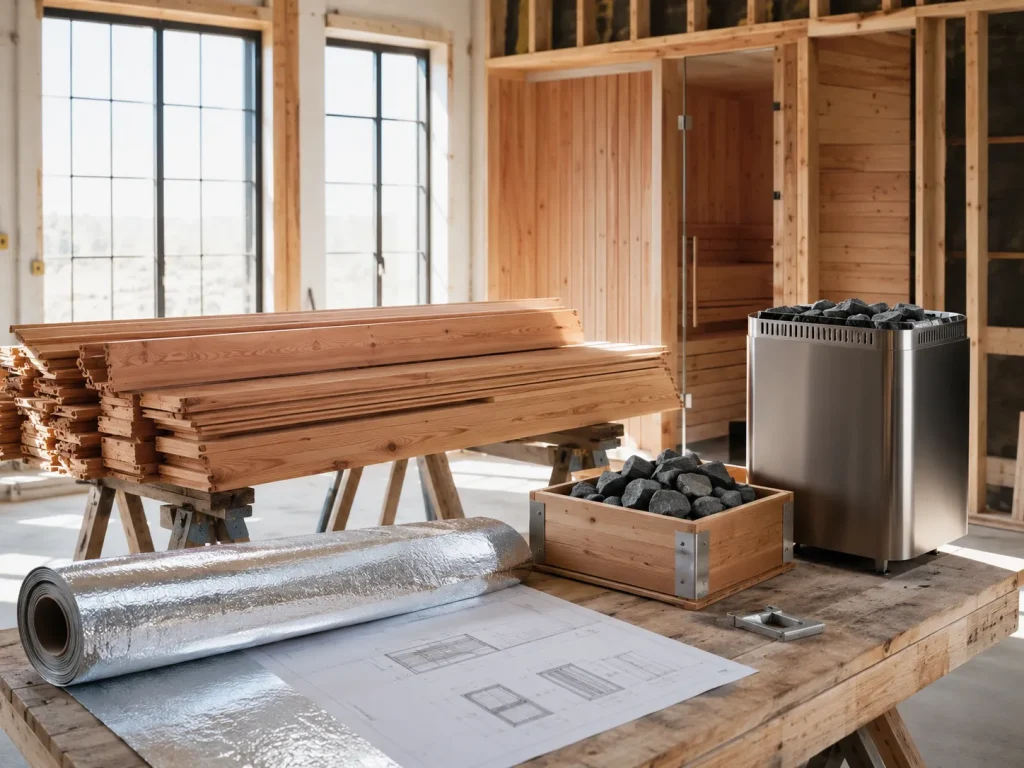
A precut kit is the classic and the most common. You get the interior timber cut to length, bench material, a door, usually a heater and stones, and fixings. What you do not get is the room: you frame it, insulate it and install the vapor barrier yourself. It suits somebody converting an existing space such as a basement corner or a spare closet.
A prebuilt or modular kit arrives as finished panels that bolt together, insulation and barrier already inside. It is the fastest route by a wide margin and often the only realistic one for somebody without carpentry experience. You pay for that in money and in flexibility, since the sizes are what they are.
Plans only means drawings and a cut list. You buy every stick of timber, every fixing and the heater separately. It is the cheapest paper on the SERP and the most work, and it is really a scratch build with the design decisions made for you.
And a scratch build is no kit at all, which is a legitimate route with the most control and the most ways to go wrong. It is a sequence of decisions rather than a shopping list, and the order matters more than the materials do.
What every kit leaves out
This is the part that produces the unpleasant surprise after delivery, and no product listing puts it near the price.
Almost no kit includes the electrical work. An electric heater wants its own 240 volt supply brought out to the unit, which is a licensed trade, a line item nobody quotes you, and usually a permit on top. A wood-fired kit avoids the wiring and substitutes a flue, clearances and its own approvals.
Most kits do not include the base either. Prefabs and modular units need a level, load-bearing pad, and a gravel base or patio blocks are a weekend and a delivery of aggregate.
Precut kits generally do not include framing lumber, insulation or the vapor barrier, which are the actual structure. And delivery on anything modular is a freight item, not a shipping charge.
None of that makes kits bad value. It makes the headline price incomplete, and the sensible move is to price the whole project rather than the box. Our breakdown of what building one costs works through the full picture rather than the sticker.
Which route suits you
A short honest test. If you have framed a wall before and own a decent saw, a precut kit will save you time and probably money over a scratch build, and the cutting list being right is worth real money in avoided mistakes.
If you have not, buy modular. People routinely underestimate this build, and the two steps that punish inexperience are the vapor barrier and the ventilation, both of which arrive already done in a panel system. A modular unit costs more and it removes the two failure modes that are expensive to discover later.
If your interest is the building as much as the sauna, buy plans or work from scratch, and enjoy it. That is a legitimate reason and it is why a lot of the best backyard saunas exist. It also helps to have decided the format first, since barrel, cabin and trailer builds are not interchangeable once the timber is cut.
What to check before ordering
Ask for the heater make, model and kilowatt rating rather than accepting “heater included”. The heater is the working part and heaters are bought in rather than made by most sauna companies, so it is the component you can compare across brands.
Ask what timber the interior is, since low-resin species such as cedar, alder and thermally modified aspen behave properly at temperature and cheaper resinous wood does not.
Ask if the door opens outward, and confirm there is no lock. Ask what the ventilation provision is, because a kit that says nothing about it has probably not provided any. And check the room volume against the heater rating rather than trusting a person count, since advertised capacity and comfortable capacity are different numbers.
Finally, settle the heat source before you shop, because it changes which kits are even candidates. The practical differences between burning wood and using an element matter more than any feature list, and if infrared is still in the running, be aware it is a different product rather than a variant. The kit will also quote a maximum temperature, which is worth reading against what each format realistically holds.
Before you buy any of them
The most expensive mistake here is not choosing the wrong kit. It is buying any kit before knowing what kind of heat you actually like, since the room you build is difficult to change afterwards. Sit in a wood-fired room at proper temperature once, pay attention, and you will know which half of this page applies to you. A single session costs less than the delivery charge on most of these kits, and being realistic about how often you would use it is worth doing before rather than after.