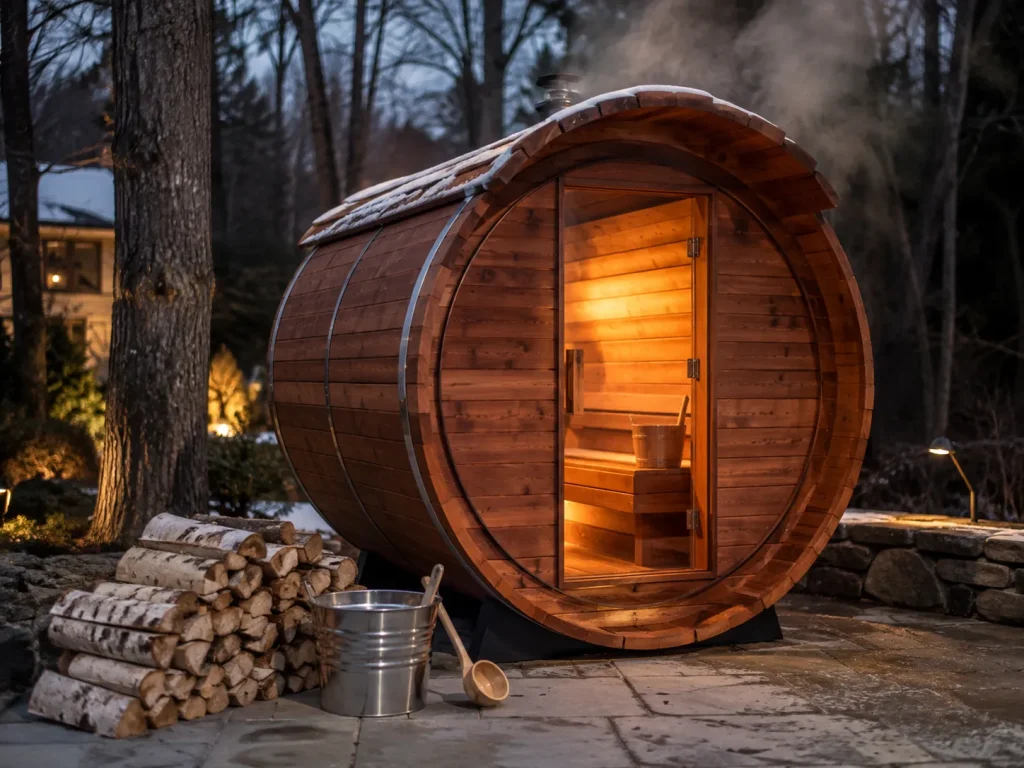
Almost every outdoor sauna guide opens the same way, with a list of models and a photograph of steam rising off a cedar barrel at dusk. That order is backwards. By the time most people get to choosing a model, two things have already ruled out half the market for them, and neither one is a matter of taste. One is the electrical panel in the basement. The other is the shape of the yard.
A note on where this is coming from, because it should change how you read it. We rent mobile saunas out, so we have an obvious commercial reason to talk you out of buying one. Take that into account. What follows is the sequence we would work through if we were spending our own money, including the parts that argue for buying.
Start with your electrical panel
An electric heater sized for a four to six person outdoor room is usually 6kW to 8kW. That is not something you plug in. It needs a dedicated 240 volt circuit on a 40 amp breaker, run from your panel out to the sauna, and in most yards that means a trench.
This is the number that surprises people. If your panel has spare capacity and the sauna is going twenty feet from the house, the electrical work is a modest line item. If your panel is full, or the run is a hundred feet across a driveway, an electrician can quote more than the sauna itself costs. Get that quote before you get attached to a model, not after the pallet arrives.
A wood-fired unit sidesteps the whole problem. No circuit, no permit for the electrical work, no trench. You pay for it in a different currency: you have to light it, feed it, and wait. The practical differences between wood-fired and electric heat go well beyond convenience, and the choice is worth making on the experience rather than on the wiring alone. But if the wiring is the thing standing in your way, wood-fired is the answer that removes it.
Then let the yard decide the size and shape
Prefabricated units arrive assembled on a trailer or a flatbed. Kits arrive on pallets. Both have to physically reach the spot you have chosen, and this is where plans quietly die. Measure the gate. Look up at the branches over the side path. Notice the slope, because a sauna needs to sit level and a sloping yard means either a stepped foundation or a lot of gravel.
You also need a base. A compacted gravel pad or patio blocks will do for most barrel and cube units. Heavier cabin builds want something closer to a poured slab. And you need clearance around the structure: air on all sides so the exterior can dry, room to open the door fully, and enough distance from your fence and your property line to satisfy local setback rules. Some towns want a permit for the structure, most want one for the electrical work.
The clearance and access questions are the same ones we work through before every delivery, and the space and access requirements for a sauna on a residential lot apply to a permanent build just as much as to a trailer that leaves again on Sunday.
Heater type is where the experience is really decided
There are three options sold under the same word, and one of them is a different product.
Traditional heat, from either a wood stove or an electric heater, warms the air and a pile of stones. The room runs somewhere between 175 and 195 degrees Fahrenheit, and pouring water over the stones gives you the burst of steam that Finnish practice calls loyly. That steam is not a garnish. It is most of what people mean when they say a sauna felt good.
Infrared does something else entirely. It heats your body directly using emitters, and leaves the air alone at roughly 120 to 150 degrees. There are no stones and no steam, and no way to add either. Indoors, in a small insulated cabinet, that works well and many people prefer the gentler heat. In a detached outdoor cabin in a New England February, it has a much harder job, because the air in the room stays cool and any part of you not facing an emitter stays cool with it.
This is the single most common mismatch between what somebody bought and what they thought they were buying, and it is worth reading the full comparison of infrared against traditional heat before spending anything. It is also worth knowing how hot each type actually runs, because the advertised maximum and the temperature you will realistically sit in are rarely the same number.
Barrel, cabin, or cube
Barrel units are the cheapest way to get a given number of people into a traditional room. The cylindrical shape heats evenly because there are no corners for cold air to sit in, and almost all of them ship as kits that two people can assemble in a weekend. The trade-off is headroom, since the curved wall cuts into the space above the top bench, and rain, since water can work its way between the curved staves. A shingled or metal roof cap is worth the upgrade in any climate with real weather.
Cabin units give you more usable interior for the same footprint, room for a proper changing vestibule, and a conventional pitched roof that sheds snow. They cost more and there is more exterior surface to maintain.
Cube units look the best in photographs and suit a modern house. Ask a direct question about the roof before you order one, because a flat or near-flat roof in a snow belt is a load calculation, not a style choice.
If you are still weighing formats rather than brands, the differences between barrel, trailer and tent builds cover the same ground from the other direction and include the portable options this page leaves out.
Wood species, and what freeze-thaw does to it
Three materials cover most of the market. Western red cedar is the most rot resistant and the most expensive, and it weathers to gray unless you treat it. Thermally modified spruce, sold as thermowood, has been heat treated until the sugars are cooked out of it, which makes it dimensionally stable and slow to absorb water. Untreated spruce or hemlock is the cheapest and has the shortest outdoor life.
In Connecticut the thing that ages an exterior is not summer sun, it is the freeze-thaw cycle. Water gets into the grain in the afternoon, expands overnight, and works the fibers apart a fraction at a time. A hundred cycles a winter does more damage than a hot August ever will. Before you buy, ask the seller a specific question: what is the exterior made of, does it need staining or sealing, and how often. Get the maintenance interval in writing. It is the difference between a structure you use and a structure you look after.
What the spec sheet will not tell you about winter
Published heat-up times assume a room starting at room temperature. Nobody publishes the February number. In practice a cold-soaked unit takes considerably longer to come up, and that is true of electric heaters as much as wood stoves, because the timber and the benches and the stones all have to absorb heat before the air will hold it. Plan on the wait being longer than the brochure suggests for roughly five months of the year.
Two smaller things that only show up once you own one. Door seals and hinges pick up ice, so a door that closes cleanly in October can need a shove in January. And snow accumulates against the base of the structure, which keeps the lowest boards wet for weeks at a time.
The largest winter factor is not mechanical at all. It is the distance from your back door. If using the sauna means putting boots on and clearing forty feet of path in the dark, you will use it far less than you imagine right now, in whatever month you are reading this.
Every capacity number is optimistic
A unit advertised as seating six seats six people upright, shoulder to shoulder, with nowhere to put their feet. It does not seat six people comfortably and it does not let any of them lie down. As a working rule, take the advertised number and plan around two thirds of it.
Bench depth matters more than bench length. A top bench deep enough to lie on changes the session completely, because lying down puts your whole body in the same heat band instead of cooking your head while your feet stay cool. If you are choosing between a longer shallow bench and a shorter deep one, take the deep one. It also affects how long you can comfortably stay in, which is the number that decides how much use you get out of a session.
Who actually makes these
For traditional prefabs and kits, the names that recur across the SERP are Almost Heaven, Redwood Outdoors, Dundalk Leisurecraft, SaunaLife, Backyard Discovery and Northern Saunas. On the infrared side it is Sun Home, Clearlight, SunRay and Dynamic. Look inside a traditional unit from almost any of these brands and you will often find a Harvia heater, because the badge on the outside and the company that made the part doing the work are frequently not the same.
There are deliberately no prices on this page. Sauna pricing moves with lumber, with freight and with whatever promotion is running, and any figure printed here would be wrong within a few months and would then mislead somebody. Get three current quotes for the format you have settled on, and make sure each one states clearly what is included: heater, stones, door, benches, roof, delivery, and how much of the assembly is yours.
The thing that ends more backyard saunas than any spec
It is not cost and it is not build quality. It is usage decay. The pattern is consistent enough to plan around. Bought in early autumn, used three or four times a week through November, down to a couple of times a month by March, and by the second winter it gets fired up when guests come.
Running cost is not the reason. The reason is friction: lighting it, waiting for it, and cleaning it afterwards. Every one of those is small, and together they are enough to lose to a cold evening and a sofa.
So the useful question before spending several thousand dollars is not which model is best. It is how often you currently use a sauna you do not own. If the honest answer is once a month at the gym, a unit in the garden is unlikely to change that as much as you expect. It is worth being realistic about how often sauna use actually holds up over time, and the full case for renting against buying works through the arithmetic properly.
A cheaper way to answer all of this
Every question on this page can be tested for a fraction of a purchase price. Renting a unit for a weekend tells you how your yard handles delivery and access, and how a wood-fired room compares to the electric one at your gym. It also tells you if pairing the heat with a cold plunge is something you would keep doing or something you tried twice. Most usefully, it tells you your real frequency, measured over a couple of days rather than guessed at in advance.
People who buy after renting tend to buy better, because they already know which format suits them and they have stopped guessing. People who rent and then do not buy have saved themselves several thousand dollars and a structure to maintain. Both outcomes are fine. If you want to test the question before you answer it, see what is involved in renting one and go from there.