
The most read page on this search is a Reddit thread asking if any portable sauna is worth buying. The most asked question underneath the results is the same doubt in different words. That tells you something useful about who is searching, and it is not somebody who wants a ranked list of nine products.
So here is the more useful answer. The phrase covers four products that have very little to do with each other, and only one of them heats the air around you. Once you know which one you are looking at, most of the confusion in this category goes away.
For transparency: we rent wood-fired saunas, which gives us an obvious reason to be sniffy about cheaper alternatives. We have tried not to be, and some of what follows is a straight argument in their favor.
The four things sold under one phrase
Product | Heat source | Your head | Temperature | Portability |
|---|---|---|---|---|
Pop-up steam box | Steam generator | Head outside | Low | Folds into a closet |
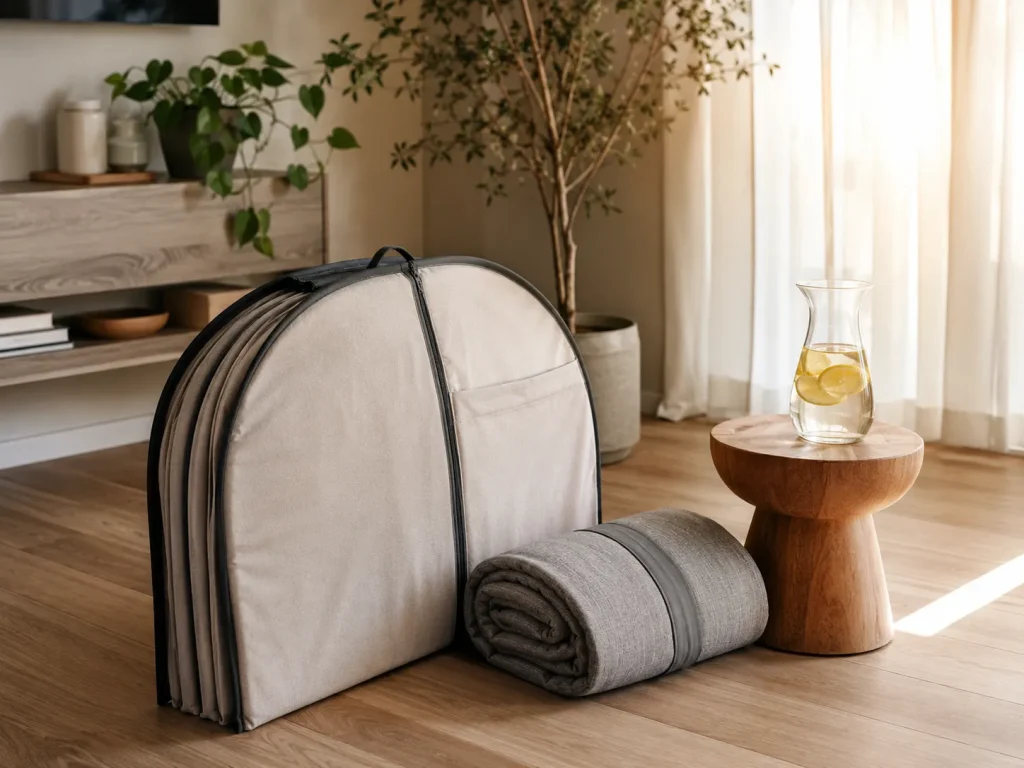
Infrared blanket | Infrared emitters | Head outside | Low | Rolls up, stores flat |
Rigid pod or cabinet | Infrared, sometimes steam | Usually inside | Low to mid | Movable, not carryable |
Tent with a wood stove | Wood fire and stones | Inside | Highest | Packs into a car |
A pop-up steam box is a fabric or plastic shell, roughly the size of a shower cubicle, with a small electric steam generator feeding a hose into it. You sit on a stool inside with your head poking out through a collar at the top. It folds away into a cupboard.
An infrared blanket is a padded sleeping-bag shape lined with infrared emitters. You lie inside it with your head out of the opening.
A rigid pod is a hard-shell single person cabinet, usually infrared, sometimes with a steam option. It moves around a room on castors and it is portable in the sense that a washing machine is portable.
A tent sauna is a canvas or technical shell with a real wood-burning stove, a flue through the roof and stones you can pour water over. It is the only one of the four that produces traditional sauna heat, and it is covered properly in our comparison of barrel, trailer and tent formats, so this page leaves it there rather than repeating the case.
The head-out problem
Three of the four leave your head outside the heat, and this is the difference that matters most. It is also the one nobody selling these products draws attention to.
In a traditional sauna you are heated everywhere at once, including the air you breathe. That whole-body heating is what produces the specific heavy, drowsy, wrung-out feeling people are chasing, and it is what the research literature was measuring when it studied sauna bathing.
With your head outside, you are breathing room-temperature air and your face and scalp are being cooled the whole time. Your body reads that as the situation being under control, which is why people can sit in a steam box or a blanket far longer than they could last in a sauna. That sounds like an advantage and it is worth thinking about carefully, because the tolerance is not a sign you are getting more. It is a sign the heat load is smaller.
This is the same mechanism that governs how long a sensible session should run in a normal sauna, running in the opposite direction. None of this makes head-out devices useless. It does mean you should stop expecting them to feel like a sauna, because structurally they cannot.
Why they all run cool
Every one of these plugs into an ordinary wall socket, which is the whole selling point. A standard household circuit gives you somewhere around 1,800 watts of usable power, and manufacturers design well below that. There is no version of that number that heats a body of air to 190 degrees Fahrenheit.
So a steam box works by saturating a very small volume with steam, and a blanket works by putting emitters directly against you. Both are sensible engineering answers to a hard power limit. They just are not the same job. If you want to see the gap in plain figures, compare them against the temperatures each sauna format actually holds.
Sweating is not the benefit
The main thing these products are sold on is how much you sweat, usually with a photograph of somebody emerging drenched. It is worth being clear that sweat is the body cooling itself, not the thing doing you good. You can produce a great deal of sweat at a modest core temperature, particularly in a humid enclosure where evaporation is blocked and your body keeps producing more because the cooling is not working.
A drenched towel is evidence that you got warm and that the moisture had nowhere to go. It is not a measure of a dose of anything.
That distinction matters for the two head-out categories in particular. If you are choosing between a steam device and an infrared one, the practical difference between dry heat and steam is worth reading, and so is the comparison of infrared against traditional heating, because the marketing for both borrows evidence collected on neither.
What they are genuinely good for
Having been blunt, here is the honest case for buying one, because it is real.
If you rent an apartment, have no outdoor space and no chance of running a 240 volt circuit, these are not the worst option available to you. They are the only option available to you. If you do have a yard, our outdoor sauna buying guide is the better starting point. A few hundred dollars against several thousand, no installation, no landlord conversation, and it goes in a cupboard when guests come.
They also do produce genuine, pleasant warmth and a real sweat, and if what you want at the end of a hard day is twenty warm quiet minutes rather than a replication of Finnish bathing culture, they deliver that well enough. Consistency counts for more than intensity. A mild device you use four evenings a week is doing more for you than an authentic sauna you visit monthly, and that holds even before you count the wider effects people are usually after.
One ownership detail that no product page mentions: the fabric ones have to be dried out after every session. Fold a damp steam box back into a cupboard a few times and you will find mold in the seams. Hang it open for a few hours. This is the most common reason these things get thrown away within a year.
Is a portable sauna worth buying
This is the question in the People Also Ask box, so here it is answered directly rather than hedged.
Yes, if you have no space, no budget for the alternative, and you want warmth and a sweat without needing it to feel like a traditional sauna. On those terms they are decent value and the low price is not a trick.
No, if you have used a real sauna and are trying to get that experience at home for four hundred dollars. You will not, and the disappointment is predictable enough that it is worth saving you the money. In that case the useful comparison is against using a facility you already have access to, or against the arithmetic of owning versus renting.
And before buying anything in this category, be realistic about how often you would actually use it. A cheap device gathering dust is still wasted money, and cheap things are abandoned faster than expensive ones because there is less sting in giving up on them.
If you want to check before you spend
The fastest way to work out which category suits you is to sit in a proper wood-fired sauna once and pay attention to what you actually liked about it. If it was the heavy whole-body heat and the steam off the stones, no head-out device is going to satisfy you and you should save toward the real thing. If it was mostly the warmth and the quiet, a blanket or a steam box will do that in your spare room for a fraction of the money, and you can stop shopping.
Either answer saves you money, which is why it is worth getting before you buy rather than after. Anyone in Connecticut can settle it in an afternoon by renting a unit for a session. It is also worth knowing who should be careful with heat exposure before starting with any of these, since the advice applies to the cheap ones as much as to the expensive ones.