
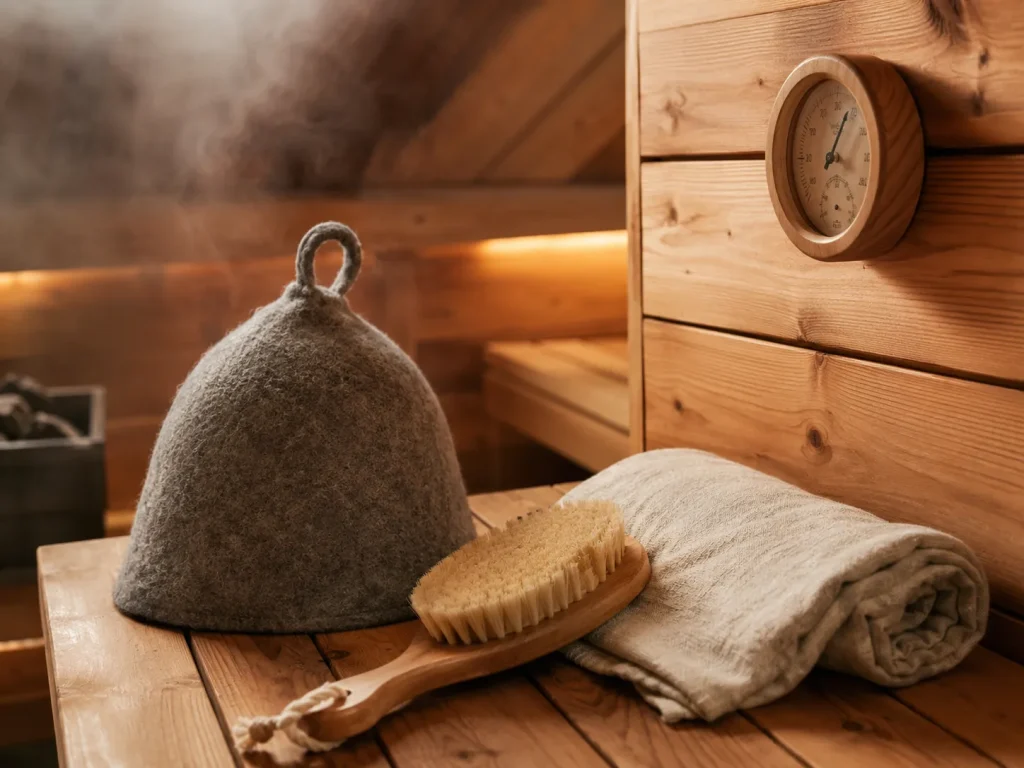
A sauna hat is a thick wool felt cap worn in the heat. It looks like a novelty and it is not one. It solves a real and specific problem, though probably not the one you would guess.
The problem it actually solves
Hot air rises, and in a small enclosed room it stacks in layers rather than mixing. The air at the ceiling is much hotter than the air at the floor, and the gap between them is larger than people expect. Sitting on a top bench you can have your head in air tens of degrees hotter than the air around your ankles.
That is not a minor detail. It is why people complain that their scalp and ears are burning while their feet are still cold, and it is the single most common complaint about sauna comfort. Your head is the part of you sitting highest in the room, and it is also the part with the least insulation of its own.
A wool hat puts insulation exactly where the air is hottest. It does not lower the room temperature, it slows the rate at which the hottest layer heats your scalp and ears. The practical result is that the limiting factor on your session stops being your head, and how long you can comfortably stay in becomes governed by your whole body rather than by the one part that overheats first.
Ears, hair and glasses
Ears deserve a separate mention. They are thin, they stick out, they have very little blood flow to carry heat away, and they sit high. In a hot room they are usually the first thing to hurt. A hat with a decent brim covers them.
Hair is the other honest reason people wear them. Repeated high heat is hard on hair, particularly if it is coloured or already dry, and a hat is a simple barrier. There is nothing wrong with that being your reason.
If you wear glasses, take them off. Metal frames get hot enough to be unpleasant against the skin and there is nothing a hat can do about that. The same thinking applies to jewellery and anything else metal, which our guidance on what to wear covers.
What it does not do
Here is where the marketing goes wrong. A sauna hat will not make you sweat more, will not help you lose weight, and does not make the session more effective in any measurable sense.
The confusion comes from sweat-suit logic, which holds that more insulation means more sweat means more benefit. A sauna hat is doing the opposite of a sweat suit: it is insulating you from the heat rather than trapping heat against you. If anything it slightly reduces the total heat load on your body, which is the entire point. The sweat-equals-results idea does not hold up anyway, as what a sauna does to your calorie burn works through, and the fluid you lose in a session is not what people hope it is.
Why wool, and why not a towel
Wool felt is the standard material for one reason: wool keeps most of its insulating value when damp. Your hat will get damp, from steam and from your own head, and cotton loses its loft as soon as it does. A wet cotton cap conducts heat rather than blocking it, which makes it worse than nothing.
A folded damp towel works in a pinch and is what most people improvise with, but it slumps, it needs rearranging, and once it is properly wet it stops helping. That is the whole case for owning a hat rather than borrowing a towel.
Finnish or Russian
Both, though the association is strongest with the Russian and Baltic banya, where rooms run hotter and wetter than most Finnish saunas and the hat is closer to standard equipment than to an option. In Finland it is common but not universal. Banya sits somewhere between the two rooms in our comparison of dry heat and steam, which is part of why the hat earns its place there.
Sauna hats have deep roots in Northern Europe, especially within traditional Finnish sauna culture. You will also see them worn during European steam rituals, as explained in our guide to the German sauna experience.
The temperature difference explains the split. The hotter the room, the more the head becomes the limiting factor, so the hat earns its place fastest at the top of the range. In a milder room, or in an infrared cabin where the heat works on your body rather than the air, there is much less for a hat to do. For where each format sits, our temperature guide lays them out.
Do you need one
No. Plenty of people sauna their whole lives without one and Finland managed for centuries before felt caps became a shop item.
It is worth having if your head or ears are consistently what makes you leave, if you use rooms at the hot end, or if you are protecting coloured hair. It is not worth having if you are hoping it improves the session in some deeper way, because it does not. Keep it simple: wool felt, wide enough brim to cover the ears, and hang it up to dry afterwards or it will smell. A wet hat in a bag is the same mistake as a damp towel in a locker. If you are trying one for the first time, a private session is a low-stakes place to find out if it changes anything for you, and the basic courtesies apply the same in a hat as out of one.